Keeper workflows
Hydrolysis claims need the aquarium's pH and temperature
Compare the pH, temperature and buffer coverage of a dichlorvos hydrolysis study with a fictional aquarium record.
By FishyMag · Published
Worked formulation evidence example · Not a clinical review or treatment recommendation.
Quick answer
The published pH 8.0, 25 °C results differ even among three buffers. The fictional reef case is pH 7.7 at 24 °C with a different matrix. The supplied study does not establish a transferable rate or half-life for that aquarium.
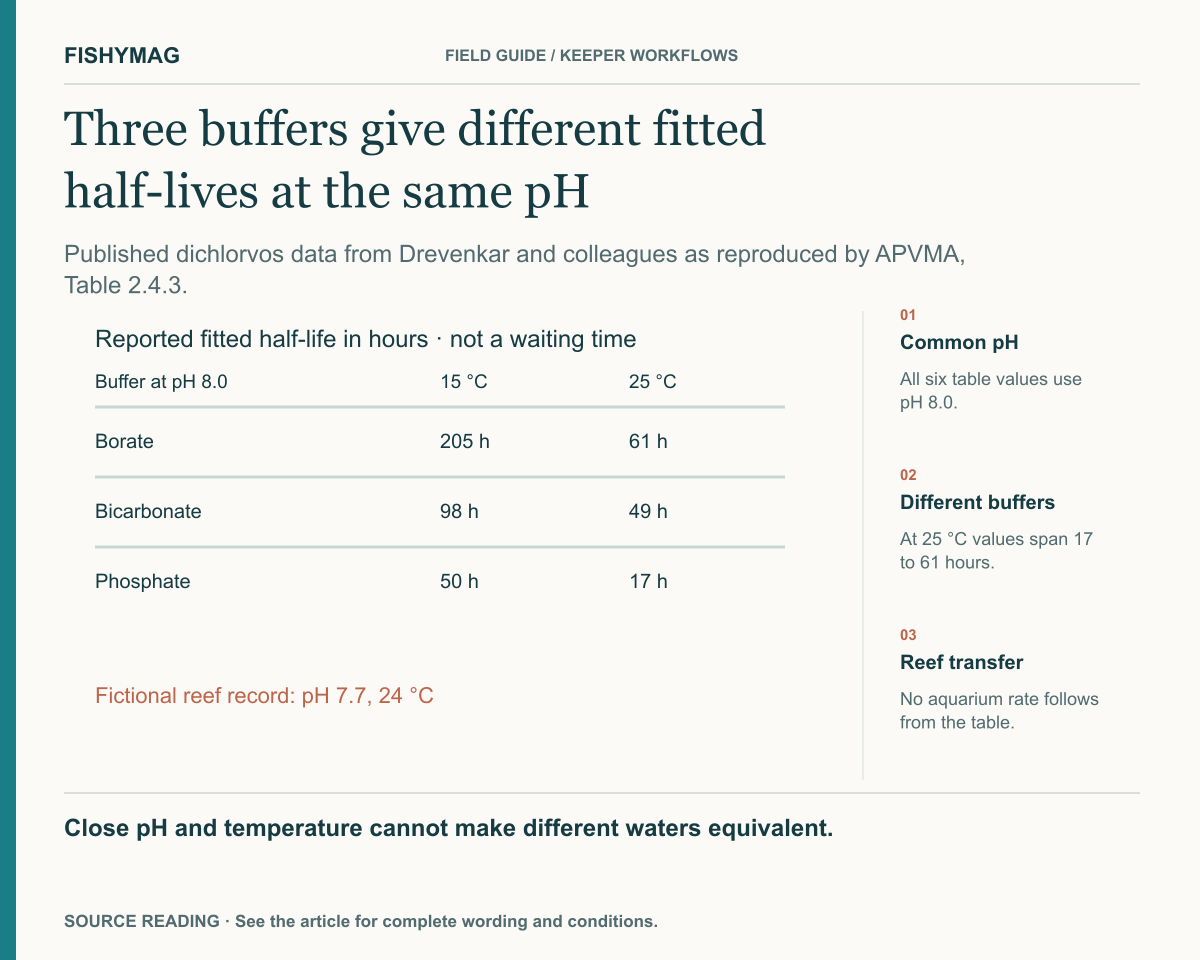
Figure data and explanation
Published dichlorvos data from Drevenkar and colleagues as reproduced by APVMA, Table 2.4.3.
- Common pH
- All six table values use pH 8.0.
- Different buffers
- At 25 °C values span 17 to 61 hours.
- Reef transfer
- No aquarium rate follows from the table.
Close pH and temperature cannot make different waters equivalent.
Compare the closest study row on all relevant dimensions
Drevenkar and colleagues studied dichlorvos hydrolysis in model and river waters. The APVMA assessment reproduces the original study’s fitted half-life values in Table 2.4.3, including three buffers at pH 8.0 and 15 °C or 25 °C. This is a chemistry example about interpreting evidence for a compound reported in aquatic literature, not an aquarium use claim.
Look at the buffer differences before inferring an aquarium rate
The fictional reader’s reef record is pH 7.7, 24 °C and saltwater. The nearest listed temperature is 1 °C away and the selected pH is 0.3 unit away, but the buffers also differ from the aquarium. These are differences in conditions, not rate corrections.
| Published buffer at pH 8.0 | 15 °C fitted half-life | 25 °C fitted half-life |
|---|---|---|
| Borate | 205 hours | 61 hours |
| Bicarbonate | 98 hours | 49 hours |
| Phosphate | 50 hours | 17 hours |
Reject an unsupported interpolation
At the same pH and 25 °C, the stated values span 17 to 61 hours for the tested buffers. The packet gives no model validated for the fictional reef matrix. A nearby pH and temperature do not justify choosing or interpolating one of the values as an aquarium rate. The comparison supplies no disappearance forecast, waiting period or use advice.
Use your own details
Hydrolysis claims need the aquarium's pH and temperature worksheet
Download the editable text file, fill it in on your device and keep it with the relevant record. This blank worksheet records your information; it does not verify entries or approve treatment.
- Exact parent compound and measured endpoint
- Study pH and temperature for each row
- Buffer, matrix and assay conditions
- Measured or fitted half-life basis
- Aquarium pH, temperature and matrix
- Differences from the nearest study row
- Reason to withhold extrapolation
Put it into practice
Your checklist
- Keep buffer and analytical basis attached to pH and temperature.
- Compare the actual conditions before considering a rate model.
- Withhold the aquarium half-life when matrix transfer is unsupported.
Sources and scope
This article distinguishes manufacturer statements from FishyMag’s own workflows and arithmetic examples. Linked formulation records retain their own evidence dates; publishing this article does not refresh those records.
- Drevenkar and colleagues, hydrolysis of dichlorvos in model and river water, 1976; reviewed November 9, 2026 ↗
- APVMA dichlorvos environmental assessment, Table 2.4; reviewed November 9, 2026 ↗
AI-assisted writing and development. Not hands-on product testing or veterinary review. How we publish →
FishyMag reports what manufacturers say, quoted and linked. It does not diagnose illness or recommend a treatment, and it never infers that a product is safe from the absence of a warning — where no statement exists, it says so.
Formulations change. Always read the label on the bottle in your hand, and contact the manufacturer if your tank contains anything valuable or unusual.