Keeper workflows
Does the aquarium heat exchanger share water?
Trace two water circuits using the Alfa Laval CB24 channel assignments and keep installed integrity unresolved.
By FishyMag · Published
Worked hydraulic example · Not a clinical review or treatment recommendation.
Quick answer
The CB24 document distinguishes channels S1/S2 and S3/S4. In the fictional drawing the two fluids occupy separate channels and exchange heat across the plates. The document does not demonstrate that an installed unit is intact or suitable for aquarium water.
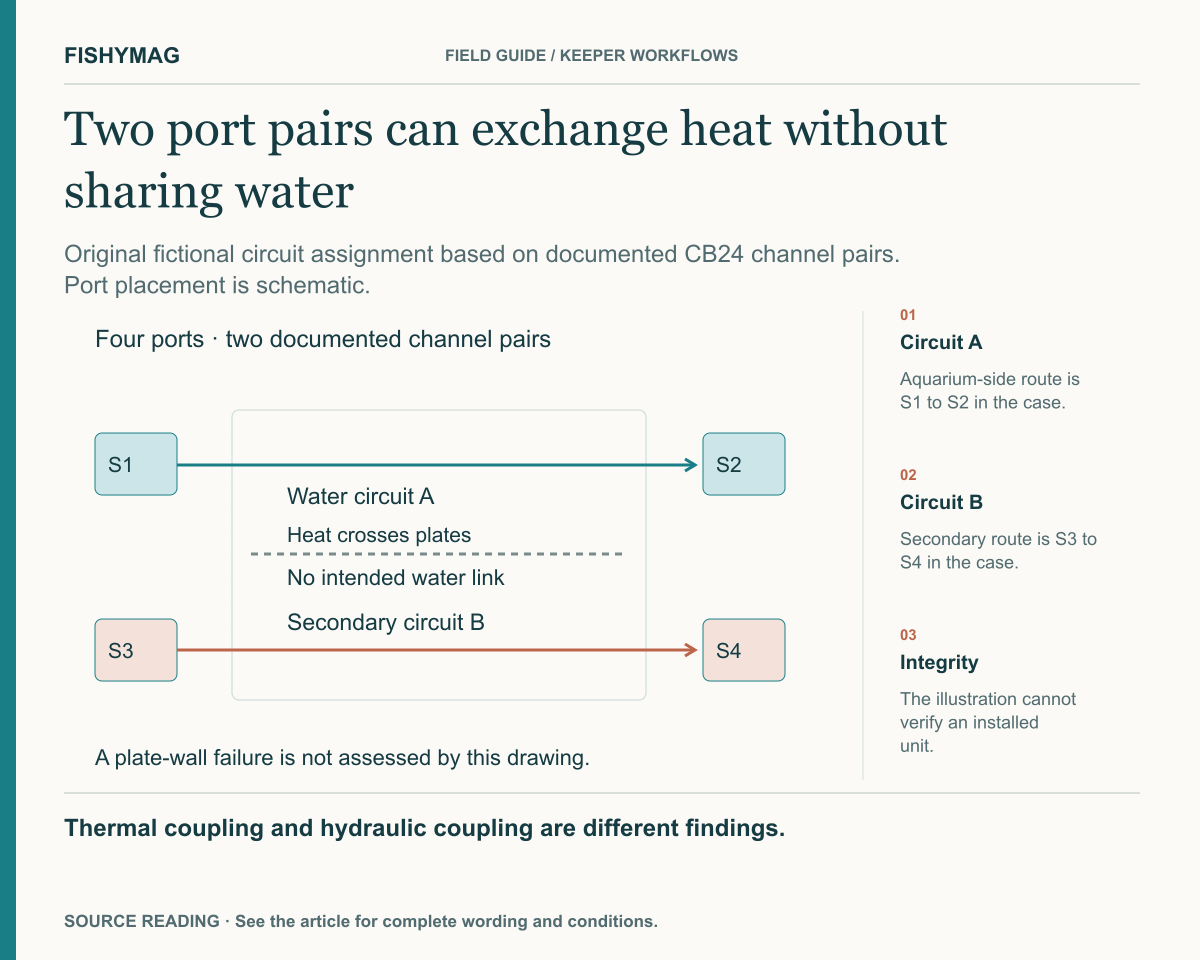
Figure data and explanation
Original fictional circuit assignment based on documented CB24 channel pairs. Port placement is schematic.
- Circuit A
- Aquarium-side route is S1 to S2 in the case.
- Circuit B
- Secondary route is S3 to S4 in the case.
- Integrity
- The illustration cannot verify an installed unit.
Thermal coupling and hydraulic coupling are different findings.
Start with channel pairs, then assign the actual fluids
Alfa Laval’s CB24 leaflet lists separate channel data for S1/S2 and S3/S4. It asks readers to obtain the configured drawing for exact values. The general brazed-exchanger manual likewise ties flow direction to the installed configuration. Our fictional record assigns aquarium-side water to S1/S2 and secondary liquid to S3/S4. Those assignments are case data, not a claim the manufacturer recommends that aquarium use.
Trace both port pairs without jumping the wall
The diagram abstracts the channel relationships. It does not reproduce the catalogue port layout or present an approved installation.
| Path | Fictional drawing | Scope |
|---|---|---|
| Circuit A | S1 to S2 | Aquarium-side route in the case |
| Circuit B | S3 to S4 | Separate secondary fluid in the case |
| Across the plate wall | Thermal connection | No intended transfer of liquid |
| Installed internal integrity | No confirming record | Cross-circuit leakage not assessed |
Do not treat the outside of the exchanger as an inspection of its channels
A photo or a drawing can help locate ports. Neither shows whether a wall has developed a fault. A connection check at the exterior also answers a different question from internal cross-circuit integrity. Keep the configured document, application and materials evidence, and any qualified integrity record distinct. The cited CB24 leaflet names copper as brazing filler; this example does not clear that material for any aquarium or livestock.
Use your own details
Does the aquarium heat exchanger share water? worksheet
Download the editable text file, fill it in on your device and keep it with the relevant record. This blank worksheet records your information; it does not verify entries or approve treatment.
- Exact exchanger code and configured drawing
- Circuit A port pair and fluid
- Circuit B port pair and fluid
- Recorded direction at each port
- Materials and application restrictions
- Evidence of installed integrity
- Unseen crossings or open questions
Put it into practice
Your checklist
- Verify the exact configured channel assignments.
- Trace both fluids independently before classifying the boundary.
- Record installed integrity and material suitability as separate questions.
Sources and scope
This article distinguishes manufacturer statements from FishyMag’s own workflows and arithmetic examples. Linked formulation records retain their own evidence dates; publishing this article does not refresh those records.
- Alfa Laval CB24 leaflet 200001406-1-EN-GB; reviewed November 9, 2026 ↗
- Alfa Laval brazed heat exchanger manual 200001565-4-EN-GB; reviewed November 9, 2026 ↗
AI-assisted writing and development. Not hands-on product testing or veterinary review. How we publish →
FishyMag reports what manufacturers say, quoted and linked. It does not diagnose illness or recommend a treatment, and it never infers that a product is safe from the absence of a warning — where no statement exists, it says so.
Formulations change. Always read the label on the bottle in your hand, and contact the manufacturer if your tank contains anything valuable or unusual.