Keeper workflows
Does the aquarium still match its handover? A fictional walkthrough
Reconcile an aquarium handover with the visible installation, preserve outdated evidence and assign unresolved discrepancies without guessing hidden connections.
By FishyMag · Published
FishyMag editorial workflow · Not a clinical review or treatment recommendation.
Quick answer
Check in both directions: locate each recorded item, then account for each relevant visible item. Record only what you can identify or trace without disturbing the installation. The completed fictional example below adds an unlisted instrument housing, marks an older photograph as superseded, and leaves a missing filter and an obscured connection unresolved with named owners.
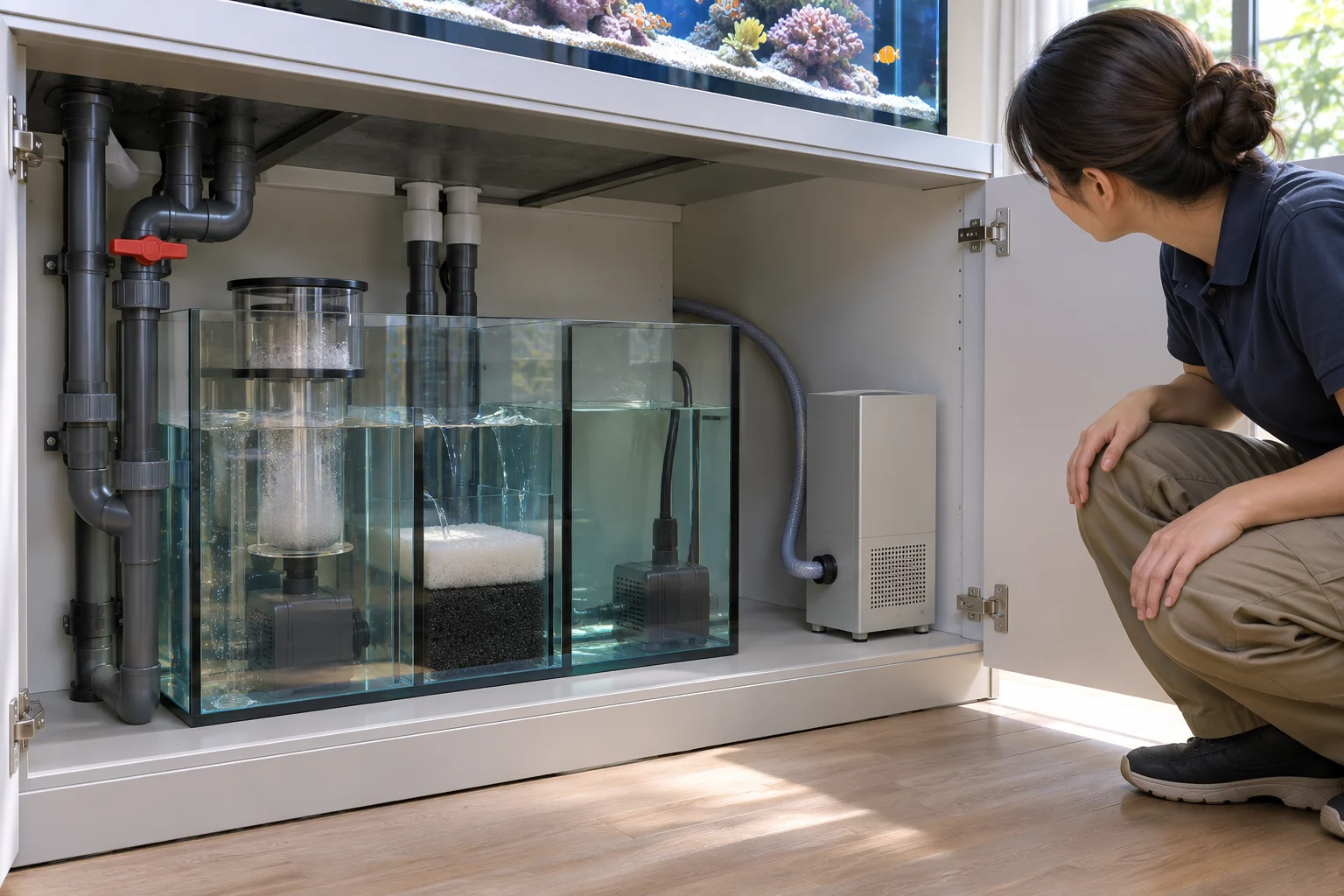
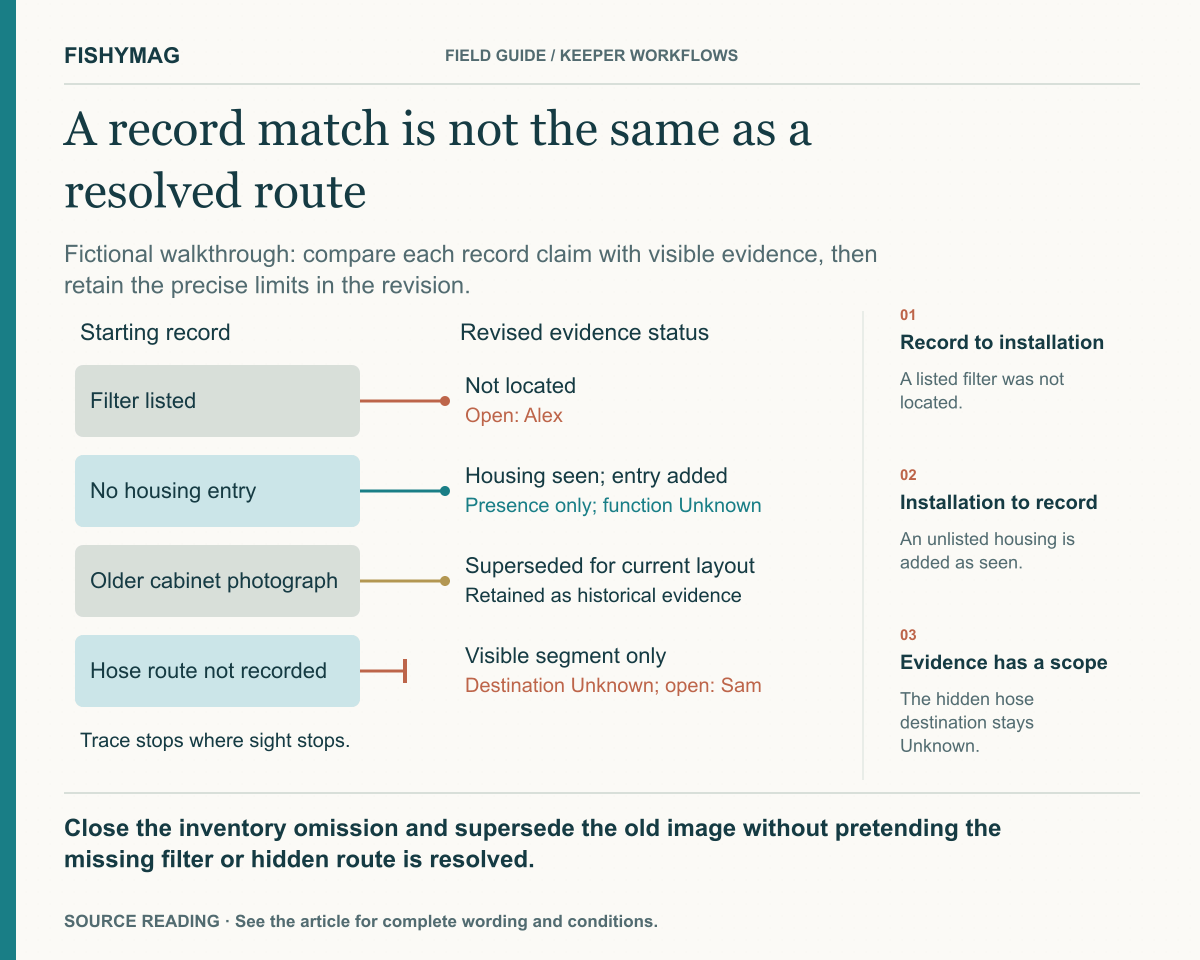
Figure data and explanation
Fictional walkthrough: compare each record claim with visible evidence, then retain the precise limits in the revision.
- Record to installation
- A listed filter was not located.
- Installation to record
- An unlisted housing is added as seen.
- Evidence has a scope
- The hidden hose destination stays Unknown.
Close the inventory omission and supersede the old image without pretending the missing filter or hidden route is resolved.
Walk the record and the installation in both directions
This is an original FishyMag record-checking workflow, not a tested inspection procedure or a certification of the installation. Its output is a reconciled inventory: what was seen, what evidence no longer represents the layout, and what remains Unknown. Start with an identifiable handover copy and record the walkthrough date. Follow a consistent location order, such as display, visible external routes, cabinet and sump. For each handover entry, note the location where you looked and whether the item can actually be identified there. Then reverse the check: scan those same locations for relevant visible apparatus or connections that the handover does not mention. Keep this a visual walkthrough. Do not move equipment, disconnect a hose, operate a valve or interrupt equipment to complete the sheet. If a route disappears behind the sump, stop the trace at the last visible point. A nearby fitting is not evidence of the hidden destination. Use narrow descriptions. “Housing visible beside sump” records an observation. “Instrument working correctly” would require different evidence. Similarly, “not located during this walkthrough” does not mean “removed from the system.”
Completed fictional case: display and sump
Everything in this case, including the people, dates, attachments and observations, is fictional. No actual aquarium was inspected. The starting document is the handover dated 2026-11-02. The fictional walkthrough takes place on 2026-11-08. Alex is the outgoing keeper; Sam maintains the revised record. The handover lists a display, sump and external filter, and includes a cabinet photograph. During the walkthrough, a separate instrument housing is visible beside the sump but absent from the inventory. A hose attached to that housing is visible only as far as the rear of the sump. The table is the completed revised inventory and evidence register. “Confirmed” means only the stated visible match. It does not establish operation, performance, water flow or suitability.
| Item or evidence | Starting handover claim | Fictional walkthrough observation | Revised record | Owner and closure evidence |
|---|---|---|---|---|
| Display | Display located above cabinet | Display seen above the cabinet; matches the recorded location | Confirmed: presence and location only | Sam retains the current overview attachment; further action Not applicable |
| Sump | Sump located inside cabinet | Sump seen inside cabinet; matches the recorded location | Confirmed: presence and location only | Sam retains the current cabinet overview; further action Not applicable |
| External filter | Filter listed beside sump | No matching filter located in the visible cabinet area or visible adjacent area | Unresolved: current location and installed status Unknown; retain the original entry | Alex to provide an identifiable current location or a specific removal record; do not mark removed meanwhile |
| Instrument housing beside sump | Not listed | Separate housing seen beside sump; a hose attachment is visible | Added: housing present at this location; identity and function Unknown and not asserted | Sam records the descriptive entry and current close view; the inventory omission is closed at this limited scope |
| Hose attached to instrument housing | Route not recorded | Visible from the housing to the point where it disappears behind the sump; far end not visible | Unresolved: destination Unknown. reason for stopping: the route beyond the last visible point is obscured | Sam to seek an existing applicable route record or a later unobstructed view; no destination entered until supported |
| Cabinet photograph | Presented as a view of the installation | Its pictured arrangement differs from the walkthrough view; in this fictional case it belongs to an older configuration | Superseded for current-layout claims; retained as historical evidence, not deleted | Sam links the current cabinet overview and records why the older image was superseded; further action Not applicable |
Close a record discrepancy without claiming more than you saw
The unlisted housing is now accounted for because the revised inventory describes its visible presence and location. That closes an omission in the inventory, not a question about what the device does. Leave identity and function Unknown rather than assigning a purpose from its shape. The photograph discrepancy is closed by changing the image's evidence role. Keep the older attachment and its original association with the handover, but mark it as superseded for current-layout claims. Link the replacement overview to the walkthrough date. A new photograph supports only what it actually shows; it does not resolve the hose route hidden behind the sump. The missing filter and obscured route remain open findings. Alex owns the filter question; Sam owns the route question. Neither owner assignment supplies the missing fact. A removal record could support a record of removal, whereas a current identifiable location could support presence there. For the hose, a diagram needs an identifiable connection to the current configuration before it can support the route claim. Do not turn “not found” into “absent,” or “visible hose segment” into “complete connection.” Do not treat the reconciled inventory as a safety clearance or a treatment-system map.
Issue a revised handover with its limits intact
Keep the starting handover unchanged as the reference copy. In the revised copy, include the walkthrough date, the completed inventory, attachment descriptions, the superseded-image note and the open findings with owners. This preserves the difference between a changed installation, an outdated record and a visibility limit. Before sharing, read the revised copy from the next keeper's perspective. Can they locate each confirmed item? Can they tell which image represents the current visible arrangement? Can they see exactly where the route trace stops? Can they distinguish a request for evidence from evidence already received? FishyMag's keeper handover tool allows a text handover and editable JSON backup to be downloaded, and the JSON can be reopened. Importing it does not authenticate its factual entries or synchronise copies. Identify the copy you share and explicitly agree which keeper holds the current revision rather than assuming another device has updated. FishyMag's evidence methodology distinguishes editorial checking workflows from clinical validation or third-party standards, and leaves missing evidence Unknown. Those limits apply to this walkthrough as well.
Use your own details
Physical-to-record reconciliation sheet
Download the editable text file, fill it in on your device and keep it with the relevant record. This blank worksheet records your information; it does not verify entries or approve treatment.
- Aquarium identity and installation location: ____________________
- Starting handover date and copy identifier: ____________________
- Walkthrough date and recorder: ____________________
- Location inspected and visibility limits: ____________________
- Recorded item and exact claim to check: ____________________
- Observed item, location and visible identifying detail: ____________________
- Current attachment reference and what it shows: ____________________
- Revised status and any reason for stopping: ____________________
- Superseded evidence reference and reason: ____________________
- Open finding owner and evidence needed for closure: ____________________
- Revised handover identifier and shared-copy recipient: ____________________
Put it into practice
Your checklist
- Match every handover entry to a visible location or retain an explicit unresolved entry; then check visible apparatus for omissions from the record.
- Mark the last visible point of each incomplete connection trace, and write destination Unknown rather than extending the route by guesswork.
- Preserve the starting handover and superseded attachments, then share a clearly identified revision with an owner and closure evidence for each open finding.
Sources and scope
This article distinguishes manufacturer statements from FishyMag’s own workflows and arithmetic examples. Linked formulation records retain their own evidence dates; publishing this article does not refresh those records.
- FishyMag evidence methodology; reviewed November 8, 2026 ↗
- FishyMag keeper handover and editable backup; reviewed November 8, 2026 ↗
AI-assisted writing and development. Not hands-on product testing or veterinary review. How we publish →
FishyMag reports what manufacturers say, quoted and linked. It does not diagnose illness or recommend a treatment, and it never infers that a product is safe from the absence of a warning — where no statement exists, it says so.
Formulations change. Always read the label on the bottle in your hand, and contact the manufacturer if your tank contains anything valuable or unusual.