Keeper workflows
Where aquarium water bypasses the equipment
Account for equipment and bypass flow at the same junction without treating the routed fraction as removal.
By FishyMag · Published
Worked hydraulic example · Not a clinical review or treatment recommendation.
Quick answer
At the fictional split, 180 L/h enters the equipment branch and 420 L/h takes the bypass. That puts 30% of the accounted flow through the equipment on that pass. It does not show how much of any substance was removed.
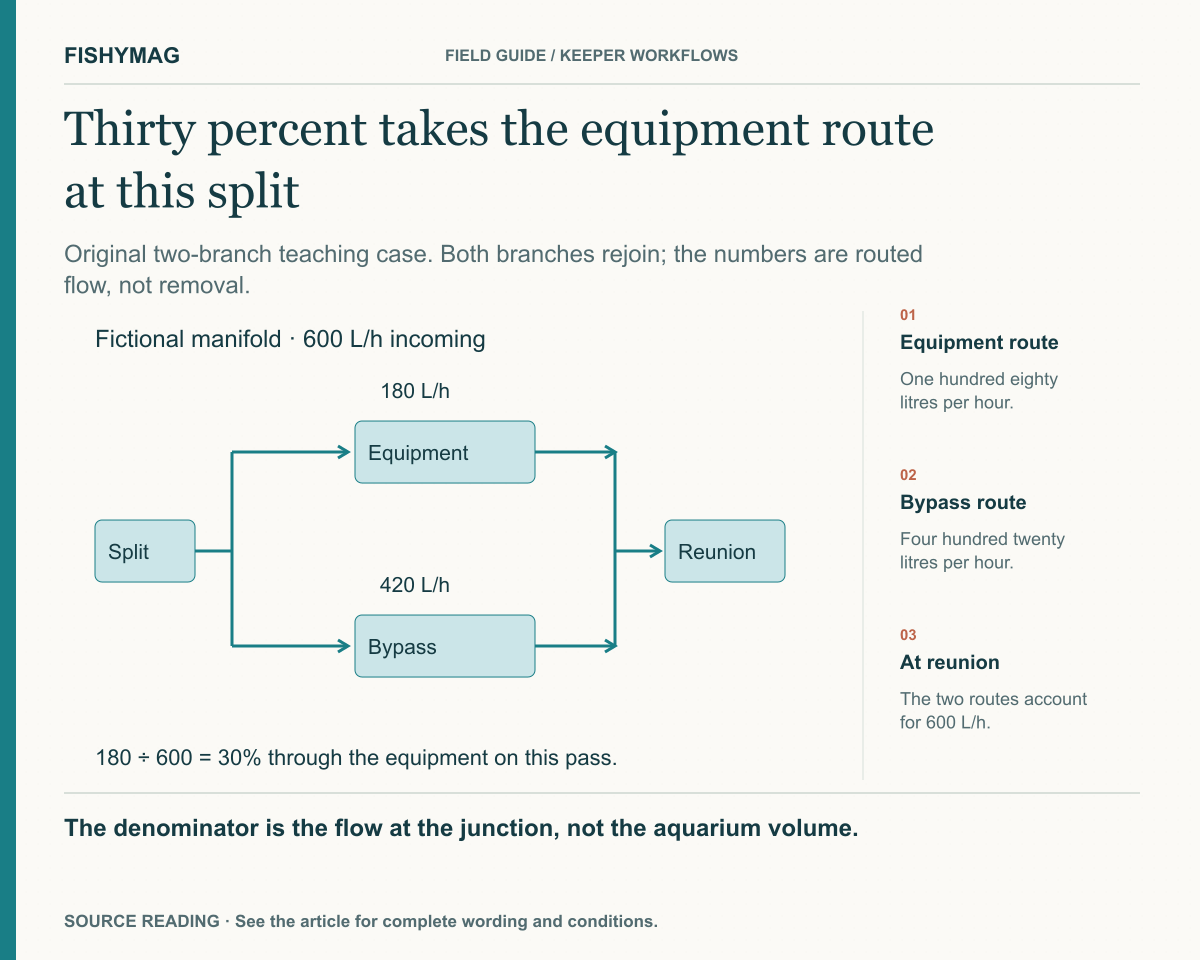
Figure data and explanation
Original two-branch teaching case. Both branches rejoin; the numbers are routed flow, not removal.
- Equipment route
- One hundred eighty litres per hour.
- Bypass route
- Four hundred twenty litres per hour.
- At reunion
- The two routes account for 600 L/h.
The denominator is the flow at the junction, not the aquarium volume.
Follow the fork until the routes meet again
The fictional manifold has two outlet routes from a single tee. One crosses a media housing; the other rejoins downstream without crossing it. The readings are simultaneous and the packet states no net storage change or unlisted route at the junction. Red Sea’s v 19A manual documents a different example: water can bypass blocked filter bags. It supplies no rates for this calculation.
Calculate the share at the split
Continuity supports the total in this particular two-route packet. Separate records taken before and after a level or valve change would not support the same sum.
| Record | Arithmetic | What it says |
|---|---|---|
| Equipment branch | 180 L/h | Routed through the housing |
| Bypass branch | 420 L/h | Routed around this housing |
| Accounted total | 180 + 420 = 600 L/h | Matched-window split |
| Equipment share | 180 ÷ 600 = 30% | One-pass hydraulic allocation |
| Chemical removal | No paired concentrations | Unresolved |
Avoid carrying a one-pass fraction around the whole loop
After the two streams reunite, the sketch does not track which water returns through which branch on its next pass. The bypass flow is not a permanently untreated 70% of the tank. Even at the housing, passage is not removal. That question needs an appropriate chemical measurement and its own assumptions. If a third branch or unequal logging windows are found, keep the 30% provisional until the split ledger is reconciled.
Use your own details
Where aquarium water bypasses the equipment worksheet
Download the editable text file, fill it in on your device and keep it with the relevant record. This blank worksheet records your information; it does not verify entries or approve treatment.
- Split and reunion drawing
- Equipment inlet and outlet
- Bypass inlet and outlet
- Same-window branch rates and units
- Measurement basis and uncertainty
- Storage or third-path check
- Routed fraction and what it cannot show
Put it into practice
Your checklist
- Locate the split and the point of reunion.
- Compare flows from the same operating window.
- Keep hydraulic allocation distinct from chemical removal.
Sources and scope
This article distinguishes manufacturer statements from FishyMag’s own workflows and arithmetic examples. Linked formulation records retain their own evidence dates; publishing this article does not refresh those records.
- US EPA EPANET 2.2 manual, network components and hydraulic equations; reviewed November 9, 2026 ↗
- US Bureau of Reclamation Water Measurement Manual, changing flow conditions; reviewed November 9, 2026 ↗
- Red Sea REEFER series manual v19A, water management system; reviewed November 9, 2026 ↗
AI-assisted writing and development. Not hands-on product testing or veterinary review. How we publish →
FishyMag reports what manufacturers say, quoted and linked. It does not diagnose illness or recommend a treatment, and it never infers that a product is safe from the absence of a warning — where no statement exists, it says so.
Formulations change. Always read the label on the bottle in your hand, and contact the manufacturer if your tank contains anything valuable or unusual.