Keeper workflows
Keep aquarium evidence attached to the right inhabitants
Audit adult fish, juveniles, shrimp and snails separately while retaining a broad invertebrate restriction.
By FishyMag · Published
Original evidence audit · Not a clinical review or treatment recommendation.
Quick answer
The fictional adult fish record applies to its own group and conditions. Juvenile fish are unexamined; the shrimp study uses different water; snails have no direct observation. The manufacturer’s fictional freshwater-invertebrate restriction remains visible for shrimp and snails.
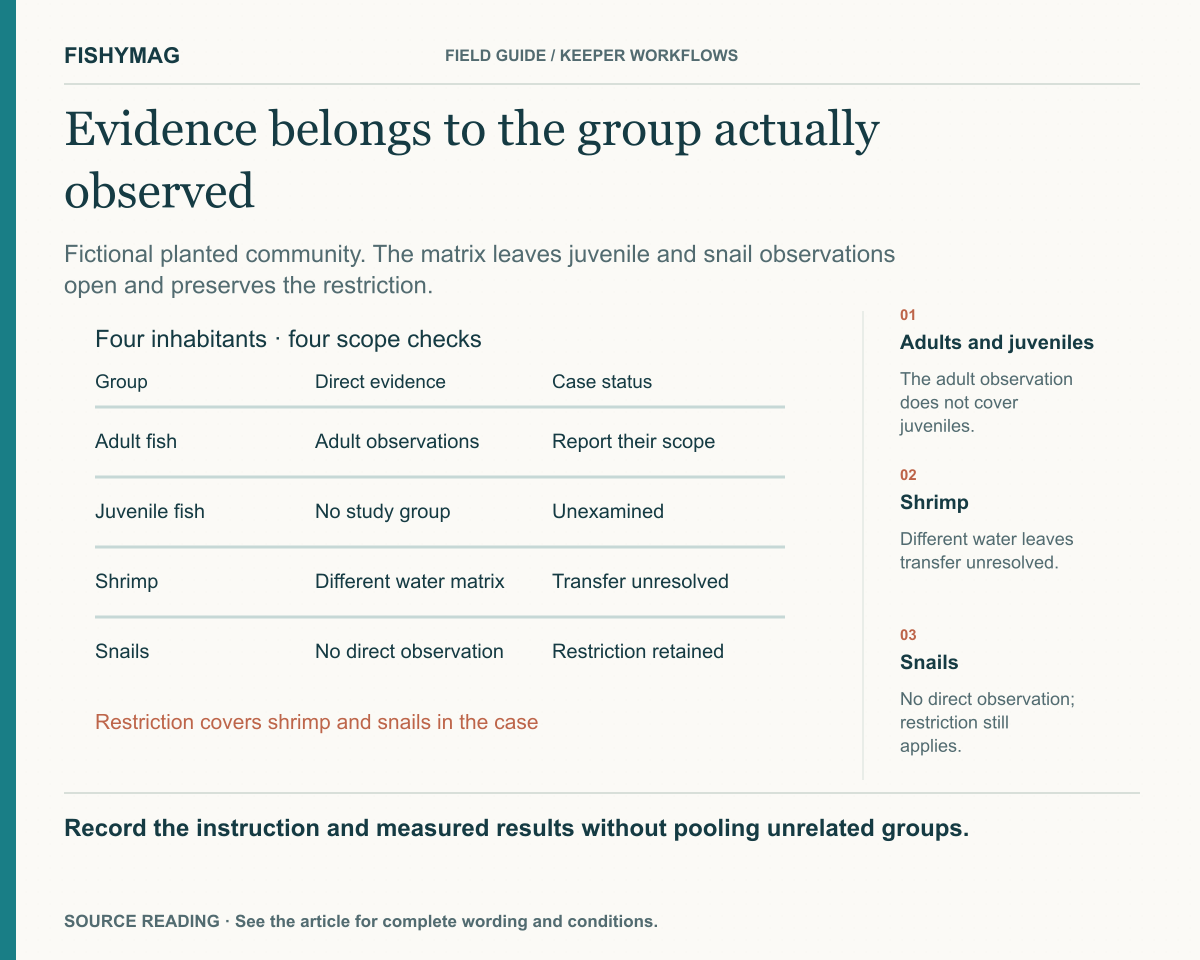
Figure data and explanation
Fictional planted community. The matrix leaves juvenile and snail observations open and preserves the restriction.
- Adults and juveniles
- The adult observation does not cover juveniles.
- Shrimp
- Different water leaves transfer unresolved.
- Snails
- No direct observation; restriction still applies.
Record the instruction and measured results without pooling unrelated groups.
List the inhabitants at the level used in the evidence
The teaching aquarium contains adult fish, juveniles, freshwater shrimp and snails. Record A reports a short adult-fish observation. Record B observes a named shrimp group in a different water matrix. The manufacturer instruction in fictional record C restricts freshwater invertebrates. No record directly observes the case snails or juveniles.
Finish four group rows instead of one pooled verdict
An applicable restriction is a separate type of evidence from a measured response. The source can be accurately reported without guessing the effect in each group.
| Group | Observation coverage | Record to preserve |
|---|---|---|
| Adult fish | Adult group observed under A conditions | Bounded observation only |
| Juveniles | Absent from A | Unexamined life stage |
| Shrimp | Group observed under different water in B | Transfer unresolved; C restriction remains |
| Snails | No direct observation | C restriction remains |
Do not let a missing subgroup inherit the best-described one
A follow-up for juveniles should name the life stage and relevant endpoint. A follow-up for shrimp should also address the matrix difference. Neither request cancels the current source restriction. This group ledger lets a reader see where each claim begins and ends without a numerical confidence or compatibility score.
Use your own details
Keep aquarium evidence attached to the right inhabitants worksheet
Download the editable text file, fill it in on your device and keep it with the relevant record. This blank worksheet records your information; it does not verify entries or approve treatment.
- Aquarium group and life stage
- Exact formulation and route
- Study population and water conditions
- Endpoint and observation window
- Direct observation, transfer gap or absence
- Manufacturer group restriction
- Follow-up evidence required
Put it into practice
Your checklist
- Record inhabitants separately, including life stage.
- Keep water-matrix differences beside the source.
- Preserve applicable instructions even where direct study data are missing.
Sources and scope
This article distinguishes manufacturer statements from FishyMag’s own workflows and arithmetic examples. Linked formulation records retain their own evidence dates; publishing this article does not refresh those records.
- Cochrane Handbook Chapter 15, applicability and interpretation; reviewed November 9, 2026 ↗
- Percie du Sert etal., ARRIVE2.0 explanationandelaboration,2020; reviewed November 9, 2026 ↗
- FishyMag evidence methodology; reviewed November 8, 2026 ↗
AI-assisted writing and development. Not hands-on product testing or veterinary review. How we publish →
FishyMag reports what manufacturers say, quoted and linked. It does not diagnose illness or recommend a treatment, and it never infers that a product is safe from the absence of a warning — where no statement exists, it says so.
Formulations change. Always read the label on the bottle in your hand, and contact the manufacturer if your tank contains anything valuable or unusual.