Keeper workflows
The aquarium water hidden in inactive plumbing
Track capped pipe volume and an intermittent auxiliary vessel across aquarium operating modes.
By FishyMag · Published
Worked hydraulic example · Not a clinical review or treatment recommendation.
Quick answer
The capped stub remains connected to the main pipe in every recorded mode, although it has no end-to-end through-flow. The auxiliary vessel changes status when its documented route opens and closes. Do not give it one permanent status in the water inventory.
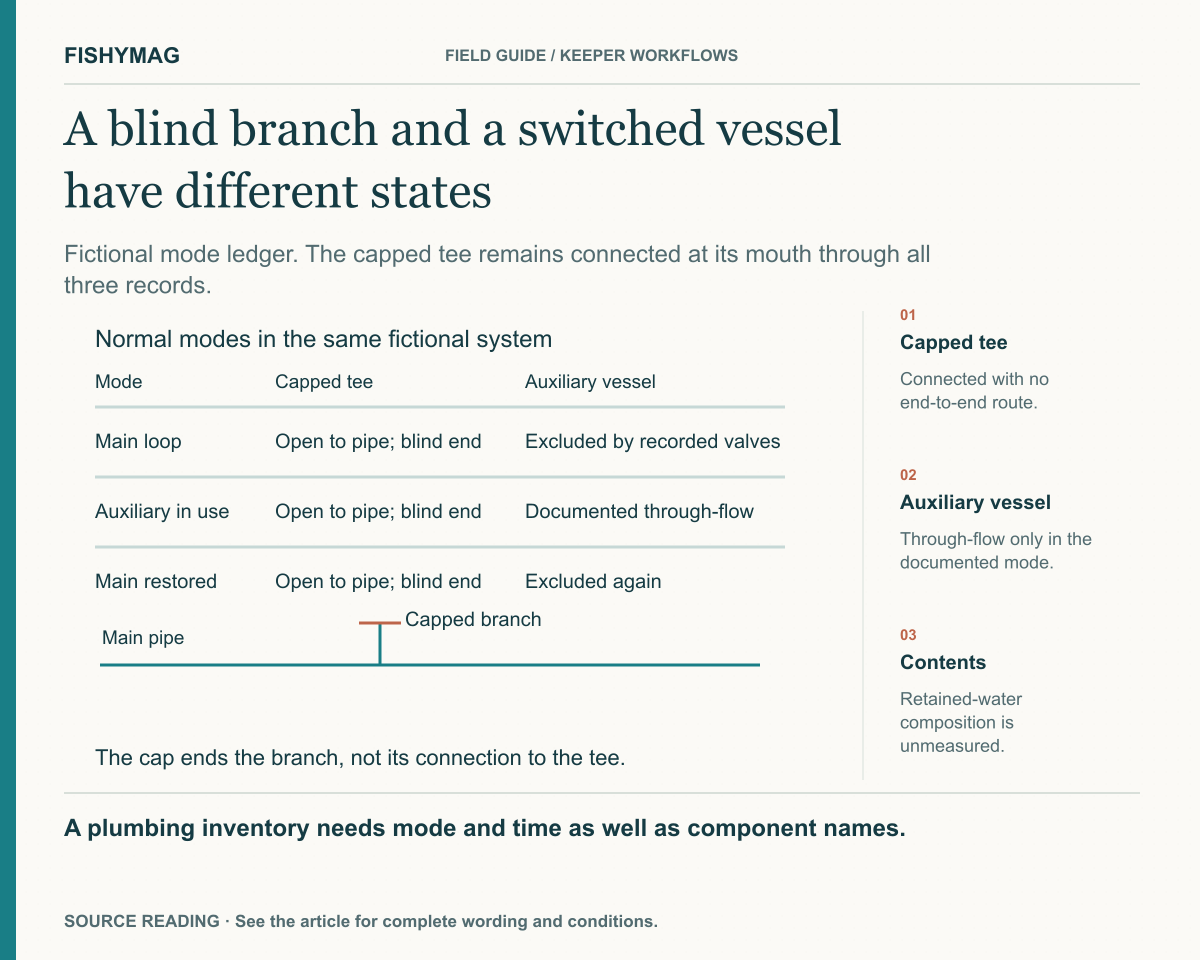
Figure data and explanation
Fictional mode ledger. The capped tee remains connected at its mouth through all three records.
- Capped tee
- Connected with no end-to-end route.
- Auxiliary vessel
- Through-flow only in the documented mode.
- Contents
- Retained-water composition is unmeasured.
A plumbing inventory needs mode and time as well as component names.
A capped end and an isolated volume are different geometries
In this fictional installation a capped tee opens into the always-used main pipe. It is closed at its far end, not at the tee. A second branch serves a vessel with recorded inlet and outlet valve states. CDC uses capped piping as a dead-leg example in building systems; the guide borrows the geometry, not the building-water control advice.
Finish the operating-mode record
Here “excluded” means the documented intended route is shut. It does not certify leakage performance or remove old water from a vessel.
| Recorded mode | Stub | Auxiliary vessel |
|---|---|---|
| Main route only | Connected blind branch | Inlet and outlet recorded closed |
| Auxiliary mode | Connected blind branch | Both open; through-flow documented |
| Main route restored | Connected blind branch | Both recorded closed again |
Carry forward what remains in the drawing
A blind branch can contain water without a dedicated through-flow route. The schematic does not measure exchange at its mouth. Nor does the second mode prove the entire auxiliary vessel was flushed. Keep the status change and time in the handover: any earlier sample, constituent finding or volume estimate should identify which modes it covers.
Use your own details
The aquarium water hidden in inactive plumbing worksheet
Download the editable text file, fill it in on your device and keep it with the relevant record. This blank worksheet records your information; it does not verify entries or approve treatment.
- Pipe and vessel IDs
- Main pipe junction and stub cap
- Operating mode and time
- Auxiliary inlet and outlet status
- Connected, blind or excluded classification
- Evidence of actual through-flow
- Unmeasured contents, exchange or residence time
Put it into practice
Your checklist
- Draw the cap and the junction at opposite ends.
- Assign a state to each volume for each mode.
- Leave exchange at a blind end unresolved without observations.
Sources and scope
This article distinguishes manufacturer statements from FishyMag’s own workflows and arithmetic examples. Linked formulation records retain their own evidence dates; publishing this article does not refresh those records.
- CDC glossary, hydraulic meaning of dead legs; reviewed November 9, 2026 ↗
- US EPA EPANET 2.2 manual, network components and hydraulic equations; reviewed November 9, 2026 ↗
AI-assisted writing and development. Not hands-on product testing or veterinary review. How we publish →
FishyMag reports what manufacturers say, quoted and linked. It does not diagnose illness or recommend a treatment, and it never infers that a product is safe from the absence of a warning — where no statement exists, it says so.
Formulations change. Always read the label on the bottle in your hand, and contact the manufacturer if your tank contains anything valuable or unusual.