Evidence literacy
Did the first aquarium exposure carry into the second?
Trace prior conditions into both second-period groups of a fictional AB/BA study when a named washout phase lacks clearance evidence.
By FishyMag · Published
Original research-appraisal case · Not a clinical review or treatment recommendation.
Quick answer
In the fictional AB sequence, period B follows A; in BA, period A follows B. A phase called washout separates them, but neither residual-exposure measurements nor endpoint-recovery evidence is supplied. Carryover remains unresolved in both second-period groups.

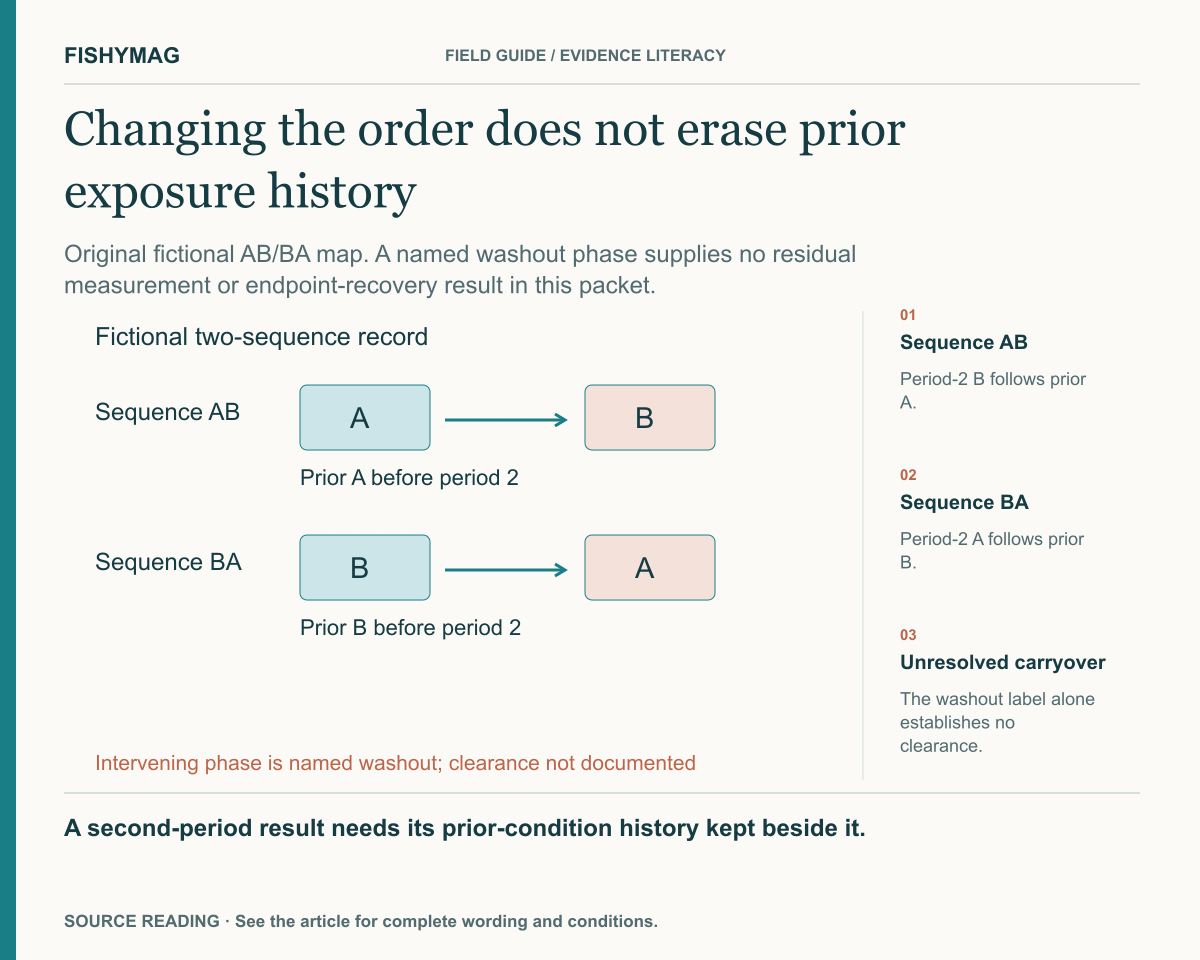
Figure data and explanation
Original fictional AB/BA map. A named washout phase supplies no residual measurement or endpoint-recovery result in this packet.
- Sequence AB
- Period-2 B follows prior A.
- Sequence BA
- Period-2 A follows prior B.
- Unresolved carryover
- The washout label alone establishes no clearance.
A second-period result needs its prior-condition history kept beside it.
Preserve the history of each second-period observation
ARRIVE discusses designs where animals serve as their own controls across periods and asks for transparent design and timing. The original fictional packet here has two sequences, AB and BA. The intervening phase is labelled washout. That label describes the intended role of a phase; it is not an analytical result or an endpoint-recovery observation. No clearance duration or biological recovery claim is supplied.
Complete the sequence-by-period map
Both second-period groups have prior exposure history. Switching the order does not erase that history, although an appropriate analysis may address aspects of the design when evidence permits.
| Sequence and period | Current condition | Earlier condition in this sequence | Carryover finding |
|---|---|---|---|
| AB, period 1 | A | None within this study sequence | No within-sequence prior A/B period |
| AB, period 2 | B | A | Prior A; carryover unresolved |
| BA, period 1 | B | None within this study sequence | No within-sequence prior A/B period |
| BA, period 2 | A | B | Prior B; carryover unresolved |
| Intervening phase | Named washout | No residual or recovery evidence supplied | Clearance not established by the name |
Ask for the relevant recovery evidence
Request existing residual-exposure results, the endpoint’s recovery evidence, the timing record and the authors’ handling of period and sequence in the analysis. A chemical measurement and a behavioural recovery observation answer different parts of the question. Absence of either in this packet does not prove persistence or a lasting effect. It prevents confirming that the intervening phase removed the relevant carryover. Do not invent an adequate interval, automatically discard the second period, or treat a balanced AB/BA order as a compatibility clearance. Preserve the original result with its design limitation until the missing evidence is resolved.
Use your own details
Did the first aquarium exposure carry into the second? worksheet
Download the editable text file, fill it in on your device and keep it with the relevant record. This blank worksheet records your information; it does not verify entries or approve treatment.
- Sequence and unit identities
- Period-1 condition
- Intervening phase as documented
- Period-2 condition
- Residual-exposure evidence
- Endpoint-recovery evidence
- Period and sequence effects addressed in analysis
- Allowed interpretation without an invented interval
Put it into practice
Your checklist
- Carry the earlier condition into every period-2 evidence row.
- Separate a washout label from demonstrated clearance or recovery.
- Request design-specific evidence without inventing a sufficient interval.
Sources and scope
This article distinguishes manufacturer statements from FishyMag’s own workflows and arithmetic examples. Linked formulation records retain their own evidence dates; publishing this article does not refresh those records.
AI-assisted writing and development. Not hands-on product testing or veterinary review. How we publish →
FishyMag reports what manufacturers say, quoted and linked. It does not diagnose illness or recommend a treatment, and it never infers that a product is safe from the absence of a warning — where no statement exists, it says so.
Formulations change. Always read the label on the bottle in your hand, and contact the manufacturer if your tank contains anything valuable or unusual.