Evidence literacy
An aquarium effect concentration is not a safety limit
Extract a fictional fitted EC50 with its endpoint convention and tested range while refusing to turn it into a safe concentration.
By FishyMag · Published
Worked arithmetic example · Not a clinical review or treatment recommendation.
Quick answer
The fictional EC50 is 0.50 mg/L with a reported 95% interval of 0.35 to 0.75 mg/L, inside the tested 0.10 to 0.80 mg/L range. In this model it means 50% probability of the specified day-4 adverse event. It is not a no-effect level or aquarium safety limit.
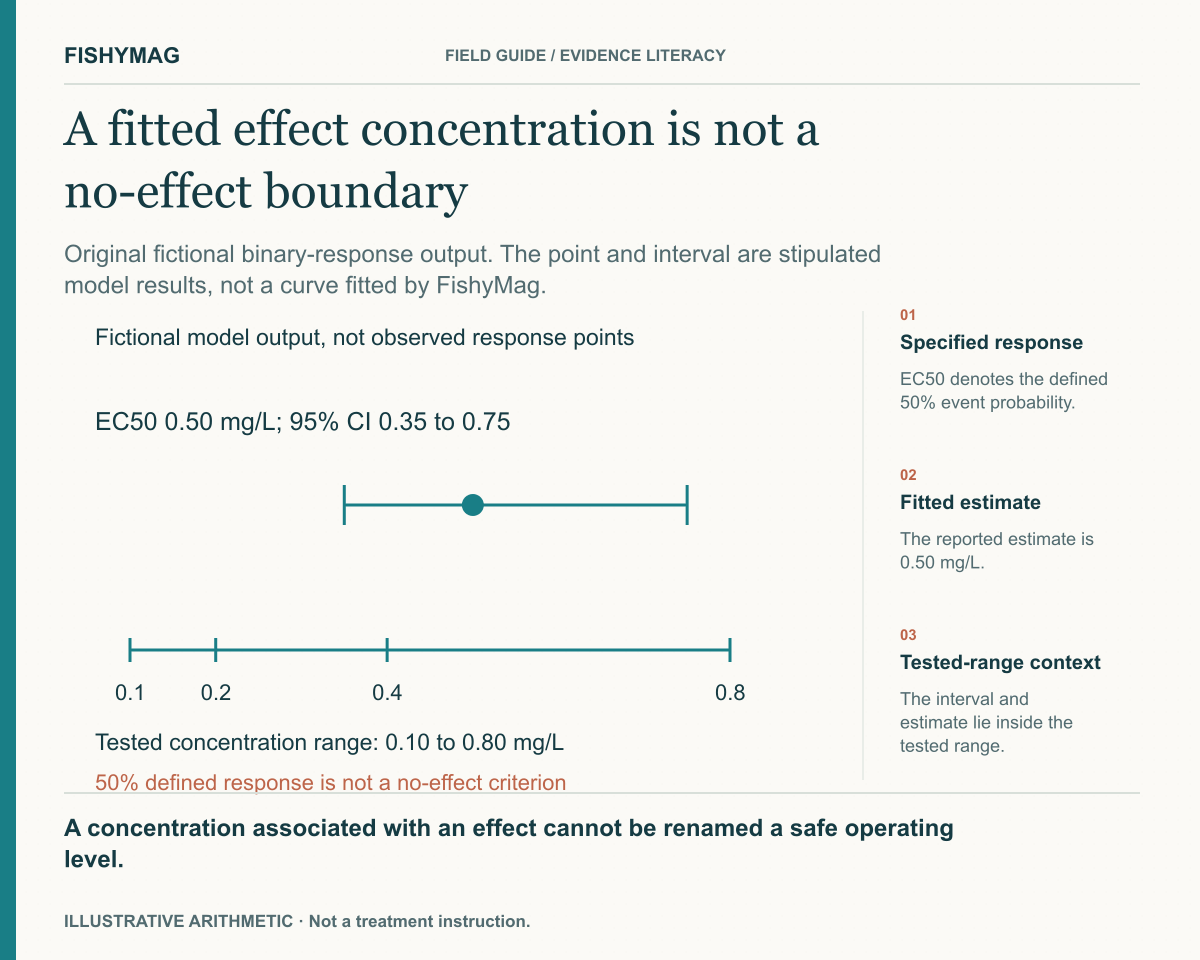
Figure data and explanation
Original fictional binary-response output. The point and interval are stipulated model results, not a curve fitted by FishyMag.
- Specified response
- EC50 denotes the defined 50% event probability.
- Fitted estimate
- The reported estimate is 0.50 mg/L.
- Tested-range context
- The interval and estimate lie inside the tested range.
A concentration associated with an effect cannot be renamed a safe operating level.
Read the endpoint convention attached to EC50
OECD’s statistical guidance explains that effect-concentration definitions need their response and background conventions. This original fictional report stipulates a fitted binary-response model with zero background event probability, whose EC50 denotes 50% probability of the defined adverse event “recorded loss of equilibrium by day 4.” No raw observations or independent fit are supplied. It is not a model of 50% reduction in growth or half of a fluorescence maximum.
Complete the extraction table
The teaching concentrations and fitted outputs below are report facts within this invented packet, not exposure recommendations or values for a named ingredient.
| Report field | Stipulated value | Bounded reading |
|---|---|---|
| Tested levels | 0.10, 0.20, 0.40, 0.80 mg/L | Tested range 0.10 to 0.80 |
| Endpoint convention | Binary adverse event by day 4; zero model background | 50% event probability at EC50 |
| Fitted EC50 | 0.50 mg/L | Inside the tested range |
| Reported 95% interval | 0.35 to 0.75 mg/L | Both endpoints inside the tested range |
| No-effect concentration | Not established by the EC50 | Do not substitute the estimate or its lower limit |
| Aquarium compatibility | No manufacturer evidence supplied | No verdict created |
Do not turn an effect level into a use limit
The estimate describes a specified model response, not an acceptable adverse-event rate. Its lower confidence limit is uncertainty about the EC50 parameter, not a conservative concentration below which every effect disappears. Being inside the tested range avoids one particular extrapolation issue but does not validate every model assumption or transfer the result to different water, life stages or horizons. Request the full fit, endpoint definition, measured exposure and model diagnostics before interpreting a real report. This article calculates no dose, predicts no aquarium outcome and establishes no safe concentration.
Use your own details
An aquarium effect concentration is not a safety limit worksheet
Download the editable text file, fill it in on your device and keep it with the relevant record. This blank worksheet records your information; it does not verify entries or approve treatment.
- Named event or continuous endpoint
- Observation duration and exposure matrix
- Fitted model and background-response convention
- Tested concentrations and measured-exposure basis
- Reported EC50 and units
- Reported interval and method
- Interpolation versus extrapolation scope
- No-effect and compatibility claims not supported
Put it into practice
Your checklist
- Recover the model’s precise response and background convention.
- Keep the estimate, interval and tested range separate.
- Do not use an EC50 or its confidence limit as a safety threshold.
Sources and scope
This article distinguishes manufacturer statements from FishyMag’s own workflows and arithmetic examples. Linked formulation records retain their own evidence dates; publishing this article does not refresh those records.
AI-assisted writing and development. Not hands-on product testing or veterinary review. How we publish →
FishyMag reports what manufacturers say, quoted and linked. It does not diagnose illness or recommend a treatment, and it never infers that a product is safe from the absence of a warning — where no statement exists, it says so.
Formulations change. Always read the label on the bottle in your hand, and contact the manufacturer if your tank contains anything valuable or unusual.