Keeper workflows
Map the evidence behind an aquarium compatibility claim
Classify six records behind an aquarium compatibility question by original source and applicable scope.
By FishyMag · Published
Original evidence audit · Not a clinical review or treatment recommendation.
Quick answer
The fictional file contains one exact-formulation study, two ingredient studies, one manufacturer restriction repeated by a retailer, and one keeper account. It contains six records and five origins. None of those counts amounts to six confirmations of compatibility.
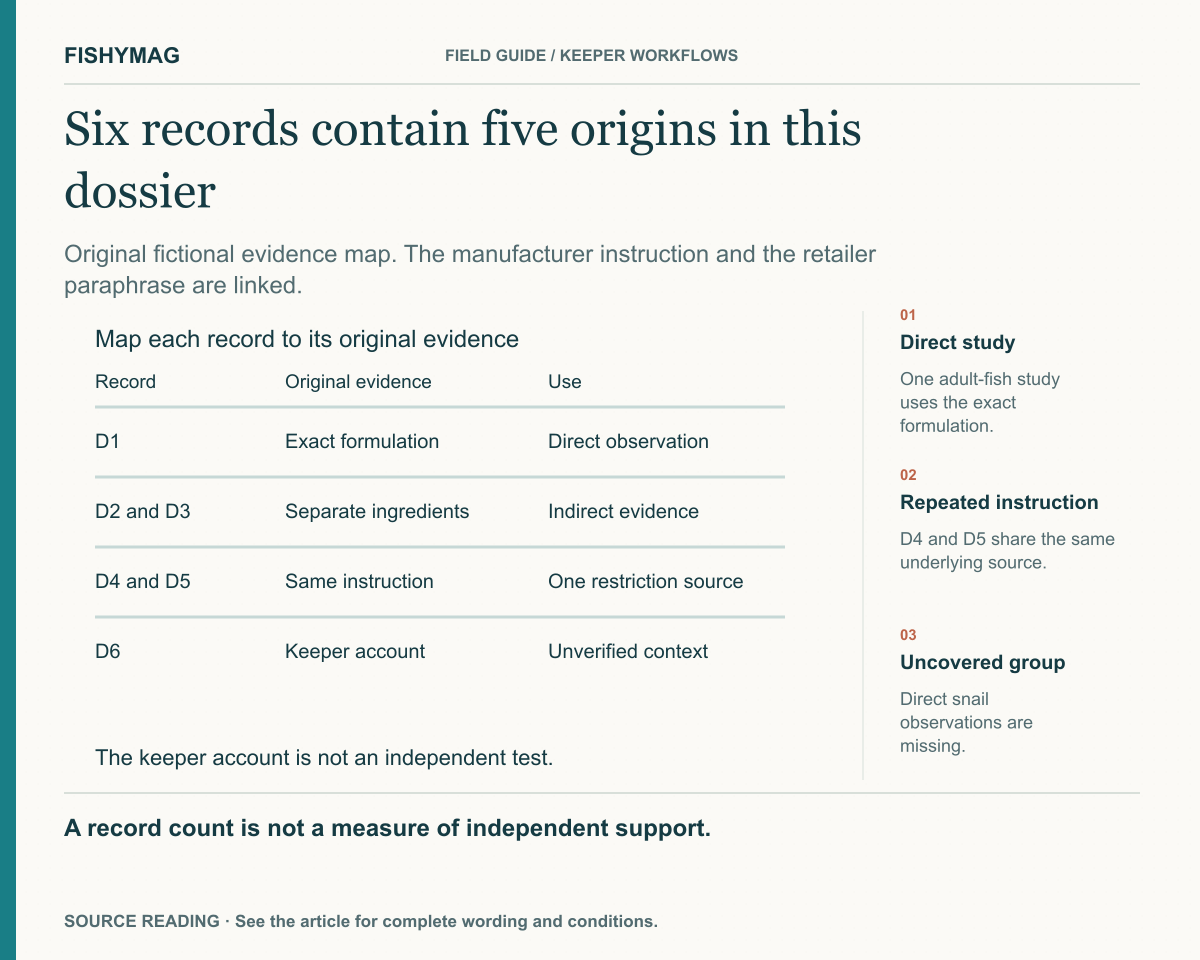
Figure data and explanation
Original fictional evidence map. The manufacturer instruction and the retailer paraphrase are linked.
- Direct study
- One adult-fish study uses the exact formulation.
- Repeated instruction
- D4 and D5 share the same underlying source.
- Uncovered group
- Direct snail observations are missing.
A record count is not a measure of independent support.
Start with the claim, then group the sources
The fictional reader asks whether product A has evidence covering a planted freshwater aquarium with adult fish and snails. The study in D1 observes adult fish with the exact formulation in its stated setup. D2 and D3 concern individual ingredients, in a different matrix or route. D4 is a manufacturer restriction covering freshwater invertebrates. D5 explicitly paraphrases it, and D6 is a keeper’s unverified account.
Complete the source-to-claim map
Keep the restriction attached to its manufacturer. Treat the retailer’s repeated wording as a route back to the same instruction.
| Record | Original scope | How to use it |
|---|---|---|
| D1 | One exact-formulation adult-fish observation | Report only its measured endpoint and conditions |
| D2 and D3 | Two ingredient studies with different scopes | Indirect; no positive compatibility inference |
| D4 and D5 | One manufacturer restriction represented twice | Preserve the restriction; do not count the paraphrase independently |
| D6 | One keeper account with incomplete conditions | Context and follow-up lead only |
Save the gaps with the sources
The file has no direct snail observation for the exact formulation. The restriction still applies to the relevant group in the teaching dossier. A more useful evidence request names the formulation, snail group, route and conditions, instead of asking for another retailer description. This is a transparent editorial map, not a regulatory weight-of-evidence assessment.
Use your own details
Map the evidence behind an aquarium compatibility claim worksheet
Download the editable text file, fill it in on your device and keep it with the relevant record. This blank worksheet records your information; it does not verify entries or approve treatment.
- Case and exact formulation
- Record ID and source date
- Underlying origin or parent source
- Organism, route and water conditions
- Endpoint or exact restriction
- Direct, indirect or anecdotal scope
- Unresolved question and next source
Worked example files
These files contain the article’s worked example. Read its source and scope notes, and keep your own current records before opening an example in a tool.
Put it into practice
Your checklist
- Record each underlying origin as well as every document.
- Keep direct observations, ingredient evidence and restrictions distinct.
- Write unresolved conditions beside the claim.
Sources and scope
This article distinguishes manufacturer statements from FishyMag’s own workflows and arithmetic examples. Linked formulation records retain their own evidence dates; publishing this article does not refresh those records.
- OECD weight-of-evidence guidance for chemical assessment; reviewed November 9, 2026 ↗
- Cochrane Handbook Chapter 5, extracting from multiple reports; reviewed November 9, 2026 ↗
- FishyMag evidence methodology; reviewed November 8, 2026 ↗
AI-assisted writing and development. Not hands-on product testing or veterinary review. How we publish →
FishyMag reports what manufacturers say, quoted and linked. It does not diagnose illness or recommend a treatment, and it never infers that a product is safe from the absence of a warning — where no statement exists, it says so.
Formulations change. Always read the label on the bottle in your hand, and contact the manufacturer if your tank contains anything valuable or unusual.