Keeper workflows
What did the aquarium study actually observe?
Separate observed outcomes from unmeasured ones and avoid turning a short aquarium study into a whole-tank verdict.
By FishyMag · Published
Original evidence audit · Not a clinical review or treatment recommendation.
Quick answer
The fictional fish report records survival through day four and feeding at the day-four check. It does not cover later reproduction. A separate plant-growth study under other conditions cannot turn those results into a whole-aquarium compatibility finding.
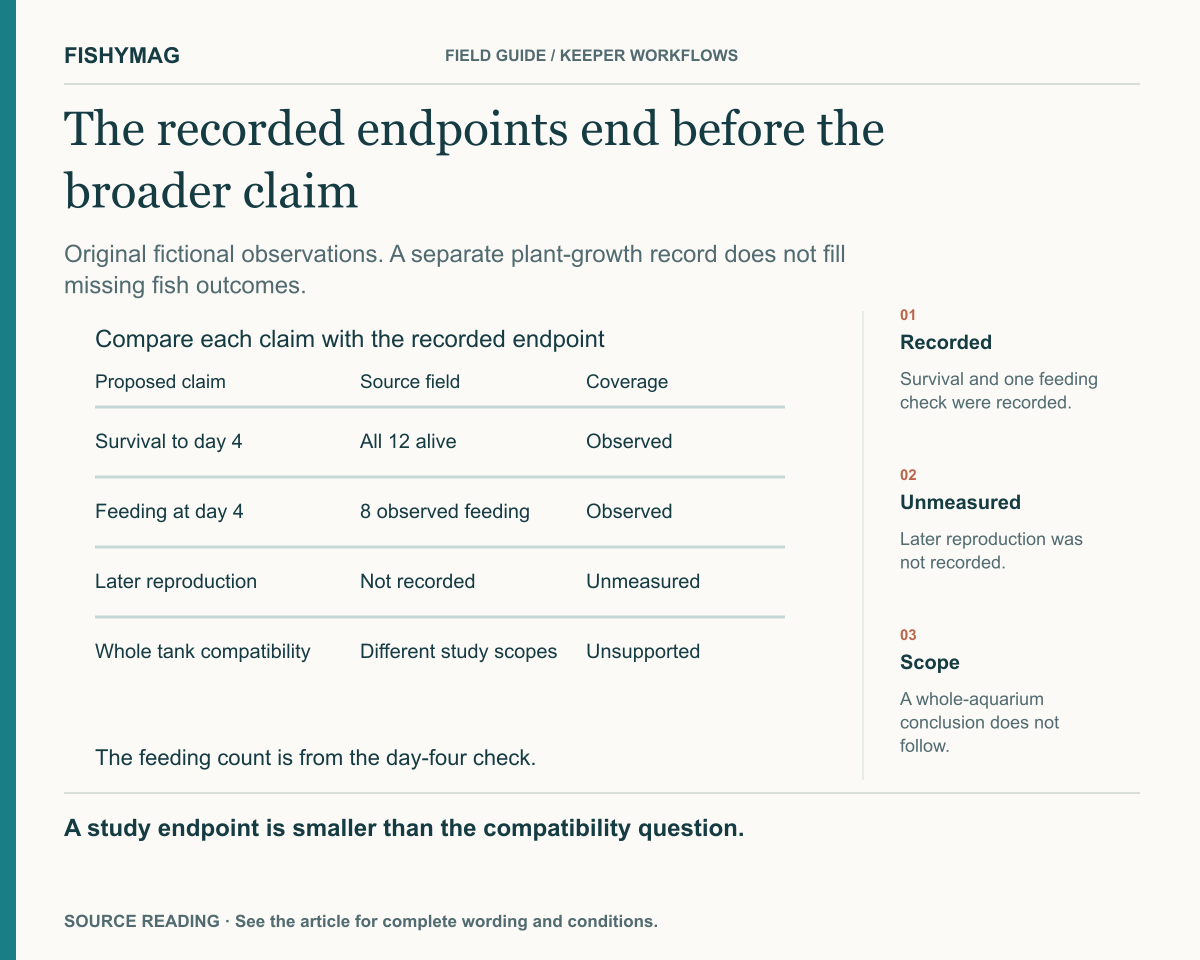
Figure data and explanation
Original fictional observations. A separate plant-growth record does not fill missing fish outcomes.
- Recorded
- Survival and one feeding check were recorded.
- Unmeasured
- Later reproduction was not recorded.
- Scope
- A whole-aquarium conclusion does not follow.
A study endpoint is smaller than the compatibility question.
Read the endpoint, denominator and last observation together
Fictional study F reports twelve adult fish observed through day four. All twelve were alive at the end and eight were seen feeding at the scheduled day-four observation. A separate study P reports new plant growth through day fourteen under a different water matrix. Neither tracked fish reproduction. These records illustrate reporting scope and are not safety tests.
Check each proposed statement before combining sources
The feeding observation is one scheduled check, not evidence that all animals fed normally throughout the window.
| Claim | Matching observation | Decision |
|---|---|---|
| Survival through day four | 12 of 12 alive at day-four close in F | Report with conditions |
| Feeding at the day-four check | 8 of 12 observed feeding in F | Report the actual observation |
| Later reproduction unaffected | Neither report measures it | Unmeasured |
| Whole-aquarium compatibility | F and P have different endpoints and conditions | Outside the evidence |
Keep the plant result without letting it stand in for fish outcomes
The plant report remains useful for its own endpoint. It cannot substitute for a missing fish, invertebrate or later-life endpoint. A summary should identify what the study ended before it could observe, so a reader can see whether a proposed conclusion extends beyond the recorded window.
Use your own details
What did the aquarium study actually observe? worksheet
Download the editable text file, fill it in on your device and keep it with the relevant record. This blank worksheet records your information; it does not verify entries or approve treatment.
- Source, formulation and water conditions
- Organisms observed and denominators
- Endpoint definition
- Observation and follow-up window
- Exact result and measurement method
- Unmeasured endpoints
- Claim scope and direct evidence gap
Put it into practice
Your checklist
- Read the endpoint definition and denominator.
- Preserve the exact last observation and conditions.
- Keep later or other-organism outcomes unmeasured when absent.
Sources and scope
This article distinguishes manufacturer statements from FishyMag’s own workflows and arithmetic examples. Linked formulation records retain their own evidence dates; publishing this article does not refresh those records.
- Cochrane Handbook Chapter 15, applicability and interpretation; reviewed November 9, 2026 ↗
- Percie du Sert etal., ARRIVE2.0 explanationandelaboration,2020; reviewed November 9, 2026 ↗
- FishyMag evidence methodology; reviewed November 8, 2026 ↗
AI-assisted writing and development. Not hands-on product testing or veterinary review. How we publish →
FishyMag reports what manufacturers say, quoted and linked. It does not diagnose illness or recommend a treatment, and it never infers that a product is safe from the absence of a warning — where no statement exists, it says so.
Formulations change. Always read the label on the bottle in your hand, and contact the manufacturer if your tank contains anything valuable or unusual.