Keeper workflows
Where an aquarium compatibility claim really starts
Trace every link in a fictional aquarium claim chain and identify the first inspectable record and the unavailable claimed origin.
By FishyMag · Published
Original source audit · Not a clinical review or treatment recommendation.
Quick answer
A, B and C form a citation loop. C also leads to D, the earliest inspectable document on this claim chain. D attributes the claim to unavailable report E. Independent note F measures a different endpoint and does not verify the claim.
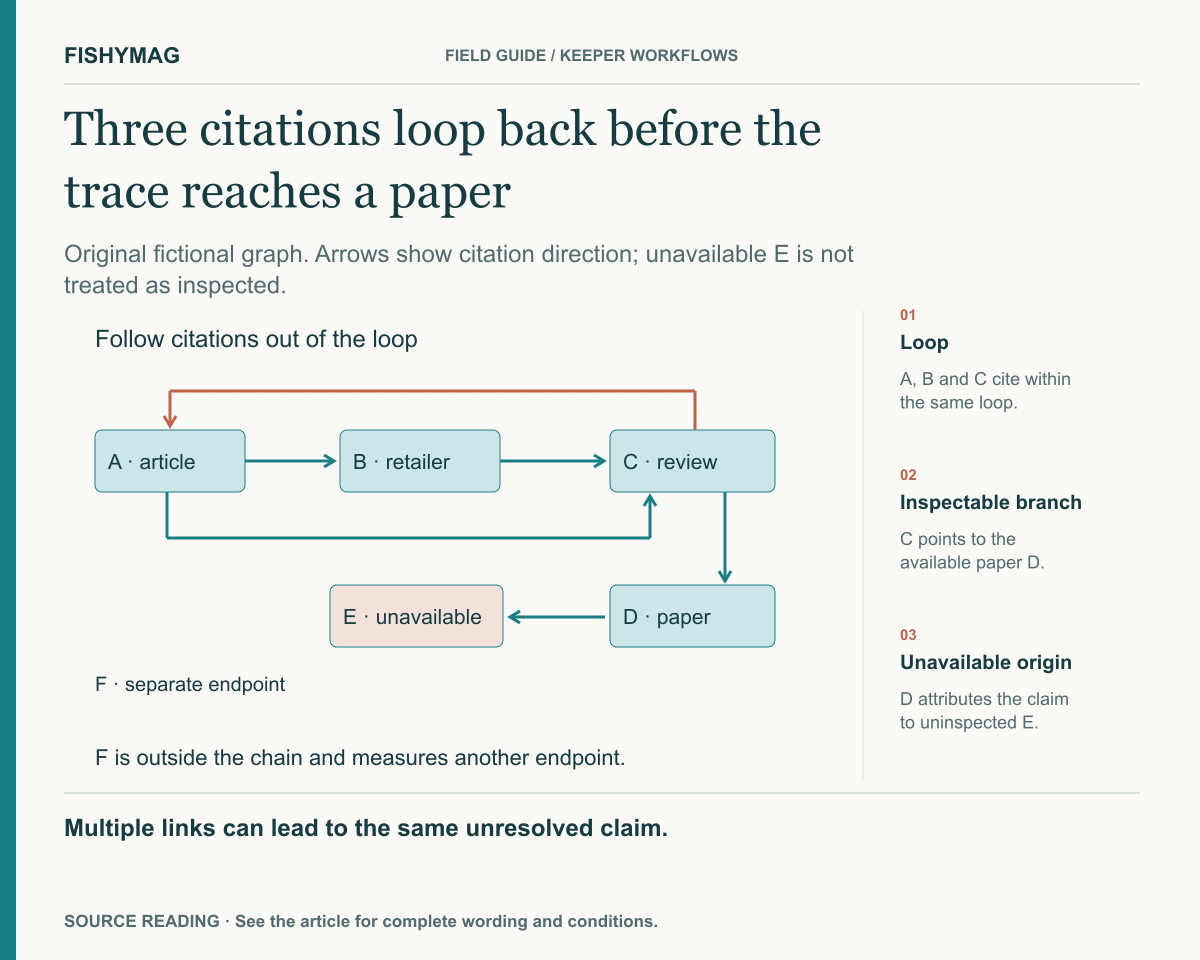
Figure data and explanation
Original fictional graph. Arrows show citation direction; unavailable E is not treated as inspected.
- Loop
- A, B and C cite within the same loop.
- Inspectable branch
- C points to the available paper D.
- Unavailable origin
- D attributes the claim to uninspected E.
Multiple links can lead to the same unresolved claim.
Follow the sentence, not just the bibliography
The fictional aquarium article A cites retailer B and review C for a broad compatibility claim. B cites C. C cites A and paper D. D attributes the statement to report E, whose full text is unavailable. The available note F records a different endpoint. Crossref reference links help navigate documents; the links do not check what each source actually supports.
Traverse and record every edge
The cycle A to B to C to A makes three records point back to one another. Follow the separate branch to D instead of restarting the loop.
| Edges | Status | Consequence |
|---|---|---|
| A to B; A to C; B to C; C to A | All inspected | Citation loop, not independent confirmations |
| C to D | D inspected | Earliest inspectable document on this chain |
| D to E | E unavailable | Claimed origin uninspected |
| F | Independent, different endpoint | Does not verify the quoted claim |
Use a narrower sentence while seeking the missing report
Write “D attributes the claim to E; we could not inspect E and found no matching result in F.” If E is recovered, record its exact conditions and endpoint before deciding whether D’s paraphrase fits. A new article citing A would add another reference, not another origin.
Use your own details
Where an aquarium compatibility claim really starts worksheet
Download the editable text file, fill it in on your device and keep it with the relevant record. This blank worksheet records your information; it does not verify entries or approve treatment.
- Exact claim and current document
- Each citation edge and passage
- Cycle or repeated parent
- Earliest inspectable record
- Claimed primary origin and access status
- Independent records and their endpoints
- Bounded wording and next evidence request
Worked example files
These files contain the article’s worked example. Read its source and scope notes, and keep your own current records before opening an example in a tool.
Put it into practice
Your checklist
- Map edges for the exact sentence.
- Separate repeated citations from the inspectable origin.
- Leave the claim unverified when the relevant primary report is unavailable.
Sources and scope
This article distinguishes manufacturer statements from FishyMag’s own workflows and arithmetic examples. Linked formulation records retain their own evidence dates; publishing this article does not refresh those records.
- Crossref reference linking documentation; reviewed November 9, 2026 ↗
- Crossref relationship types; reviewed November 9, 2026 ↗
- OECD weight-of-evidence guidance for chemical assessment; reviewed November 9, 2026 ↗
AI-assisted writing and development. Not hands-on product testing or veterinary review. How we publish →
FishyMag reports what manufacturers say, quoted and linked. It does not diagnose illness or recommend a treatment, and it never infers that a product is safe from the absence of a warning — where no statement exists, it says so.
Formulations change. Always read the label on the bottle in your hand, and contact the manufacturer if your tank contains anything valuable or unusual.