Keeper workflows
When an aquarium claim loses its primary source
Reassess each aquarium claim after a source withdrawal by tracing its actual dependence on that record.
By FishyMag · Published
Original source audit · Not a clinical review or treatment recommendation.
Quick answer
A and B lose their stated evidence because they rely only on withdrawn P. C can be narrowed to the specific observation independently supported by Q. D uses Q alone, so the P withdrawal does not change it.
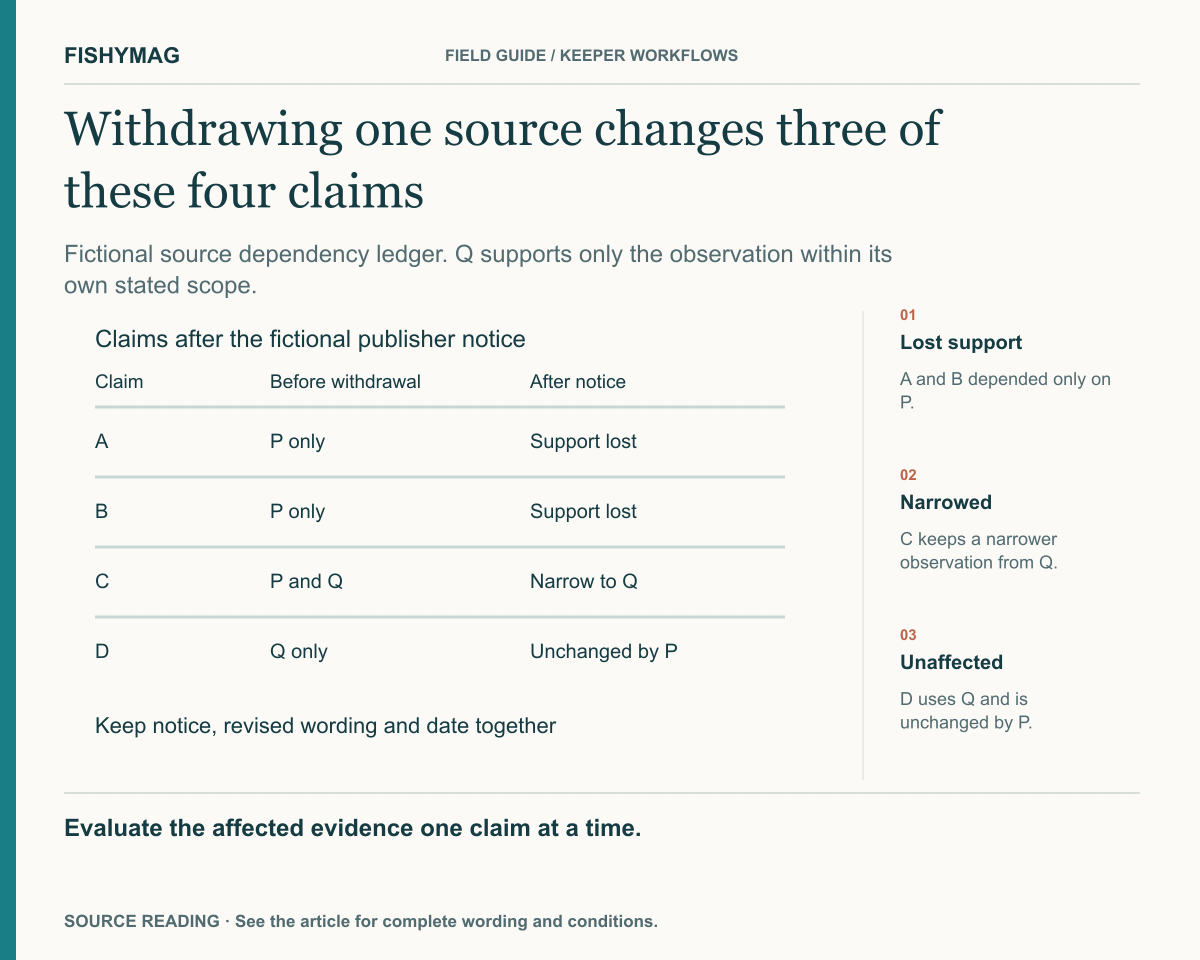
Figure data and explanation
Fictional source dependency ledger. Q supports only the observation within its own stated scope.
- Lost support
- A and B depended only on P.
- Narrowed
- C keeps a narrower observation from Q.
- Unaffected
- D uses Q and is unchanged by P.
Evaluate the affected evidence one claim at a time.
Identify the withdrawn item before revising the claims
In this fictional dossier the publisher withdraws P and says its central dataset is unreliable. That specific notice prompts removing P as support. Q is a different paper and independently records one adult-fish observation. The example is not a general interpretation of every label called “withdrawal.”
Complete a disposition for each dependent claim
The table preserves an audit trail instead of silently deleting all references or replacing P with any available paper.
| Claim | Dependency | Revised wording or action |
|---|---|---|
| A: snail response | Only P | Unverified; seek direct evidence for the exact group |
| B: later reproduction | Only P | Unresolved; seek applicable follow-up data |
| C: whole-tank compatibility | P plus narrow Q observation | Q records adult feeding at its stated check; broader claim withheld |
| D: adult observation in Q | Q only | Unchanged by P; retain Q’s original conditions |
Preserve the notice beside the revised evidence trail
Save the publisher notice and the identifiers it names. Crossref may help locate related updates; confirm their text at the publisher. Record why A and B lost their stated basis, why C narrowed and why D stayed the same. Withdrawal does not establish the opposite biological conclusion.
Use your own details
When an aquarium claim loses its primary source worksheet
Download the editable text file, fill it in on your device and keep it with the relevant record. This blank worksheet records your information; it does not verify entries or approve treatment.
- Notice, date and affected document version
- Reason and scope in actual notice
- Claim and original supporting passages
- Alternative independent evidence
- Disposition after withdrawal
- Revised bounded wording
- Unknowns and follow-up source
Put it into practice
Your checklist
- Read the actual notice and match its target.
- Trace each sentence to surviving independent evidence.
- Keep withdrawn support and current wording in the audit trail.
Sources and scope
This article distinguishes manufacturer statements from FishyMag’s own workflows and arithmetic examples. Linked formulation records retain their own evidence dates; publishing this article does not refresh those records.
- Crossref version control, corrections and retractions; reviewed November 9, 2026 ↗
- COPE retraction guidance; reviewed November 9, 2026 ↗
- OECD weight-of-evidence guidance for chemical assessment; reviewed November 9, 2026 ↗
AI-assisted writing and development. Not hands-on product testing or veterinary review. How we publish →
FishyMag reports what manufacturers say, quoted and linked. It does not diagnose illness or recommend a treatment, and it never infers that a product is safe from the absence of a warning — where no statement exists, it says so.
Formulations change. Always read the label on the bottle in your hand, and contact the manufacturer if your tank contains anything valuable or unusual.