Keeper workflows
When a chemical identifier leaves the aquarium ingredient unresolved
Distinguish racemic praziquantel, arpraziquantel and an incomplete ingredient identity before transferring a measured property.
By FishyMag · Published
Worked formulation evidence example · Not a clinical review or treatment recommendation.
Quick answer
The EMA-hosted document defines arpraziquantel as the R enantiomer and racemic praziquantel as a 1:1 mixture of R and S. A generic “PZQ” entry without a linked record does not establish the form in a bottle. Check stereochemistry and solid form before attaching a property value.
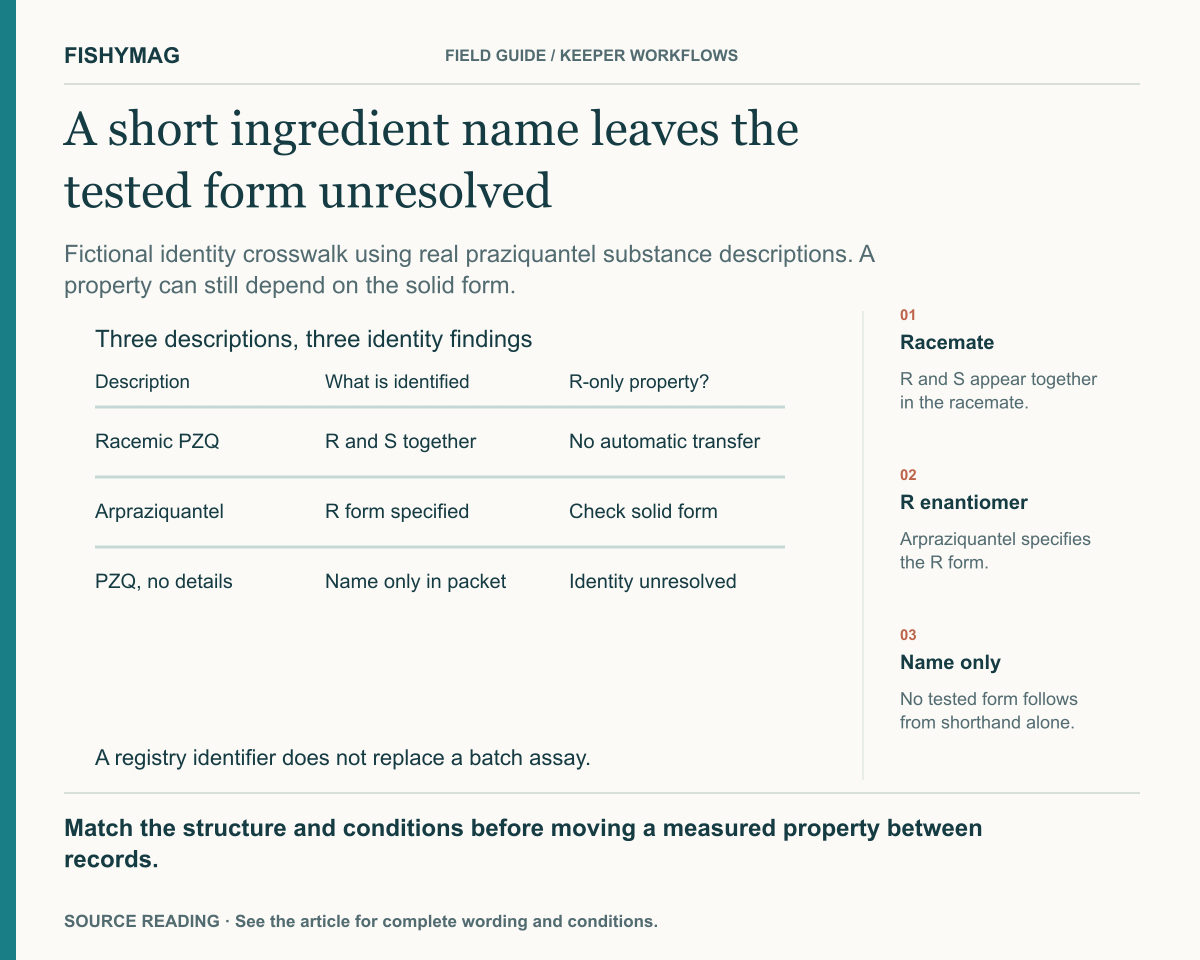
Figure data and explanation
Fictional identity crosswalk using real praziquantel substance descriptions. A property can still depend on the solid form.
- Racemate
- R and S appear together in the racemate.
- R enantiomer
- Arpraziquantel specifies the R form.
- Name only
- No tested form follows from shorthand alone.
Match the structure and conditions before moving a measured property between records.
Use the registry to locate a substance, then inspect the batch evidence
FDA’s praziquantel registry entry lists UNII 6490C9U457 and CAS 55268-74-1. The EMA-hosted arpraziquantel document distinguishes R praziquantel from the racemate. The records help interpret the descriptions; they do not assay a commercial aquarium bottle. A name or shared molecular formula may omit features that affect a solid-state measurement.
Crosswalk the three fictional descriptions
The target property comes from a test on identified crystalline R material in a documented medium. It is not automatically attached to every record containing the word praziquantel.
| Description in packet | Identity finding | Property transfer |
|---|---|---|
| Racemic praziquantel, exact identity documented | R and S together in the stated racemate | R-only value is not a racemate value |
| Arpraziquantel, R form documented | R stereochemistry established in the packet | Still check crystal form and test conditions |
| Ingredient line reads only PZQ | No linked form or composition record | Unresolved for this claim |
Ask for the missing level of identification
Request the exact substance identifier, stereochemical composition and solid form underlying the property and the compared material. Even a correct chemical registry record does not specify what was measured in a particular lot. The exercise concerns document scope, not a substitution or use judgement.
Use your own details
When a chemical identifier leaves the aquarium ingredient unresolved worksheet
Download the editable text file, fill it in on your device and keep it with the relevant record. This blank worksheet records your information; it does not verify entries or approve treatment.
- Exact text in the ingredient record
- Registry identifier and version
- R, S or racemate designation
- Evidence for composition or enantiomer ratio
- Crystal form or hydrate information
- Property study and tested form
- Identity gap that prevents transfer
Put it into practice
Your checklist
- Distinguish the registry record from a lot result.
- Match stereochemistry and solid form to the property study.
- Do not turn a shorthand ingredient line into a confirmed identity.
Sources and scope
This article distinguishes manufacturer statements from FishyMag’s own workflows and arithmetic examples. Linked formulation records retain their own evidence dates; publishing this article does not refresh those records.
- EMA-hosted arpraziquantel risk management plan; reviewed November 9, 2026 ↗
- FDA substance registry record for praziquantel; reviewed November 9, 2026 ↗
- Experimental comparison of racemic and enantiopure praziquantel in different media; reviewed November 9, 2026 ↗
AI-assisted writing and development. Not hands-on product testing or veterinary review. How we publish →
FishyMag reports what manufacturers say, quoted and linked. It does not diagnose illness or recommend a treatment, and it never infers that a product is safe from the absence of a warning — where no statement exists, it says so.
Formulations change. Always read the label on the bottle in your hand, and contact the manufacturer if your tank contains anything valuable or unusual.