Evidence literacy
Which aquarium control isolates the named ingredient?
Complete all three contrasts in a fictional untouched, carrier-only and ingredient-plus-carrier aquarium study.
By FishyMag · Published
Original research-appraisal case · Not a clinical review or treatment recommendation.
Quick answer
The ingredient group versus the identically handled carrier group addresses the added ingredient under the shared carrier and handling conditions. Carrier versus untouched compares the carrier-plus-handling package. Ingredient versus untouched compares the full package.
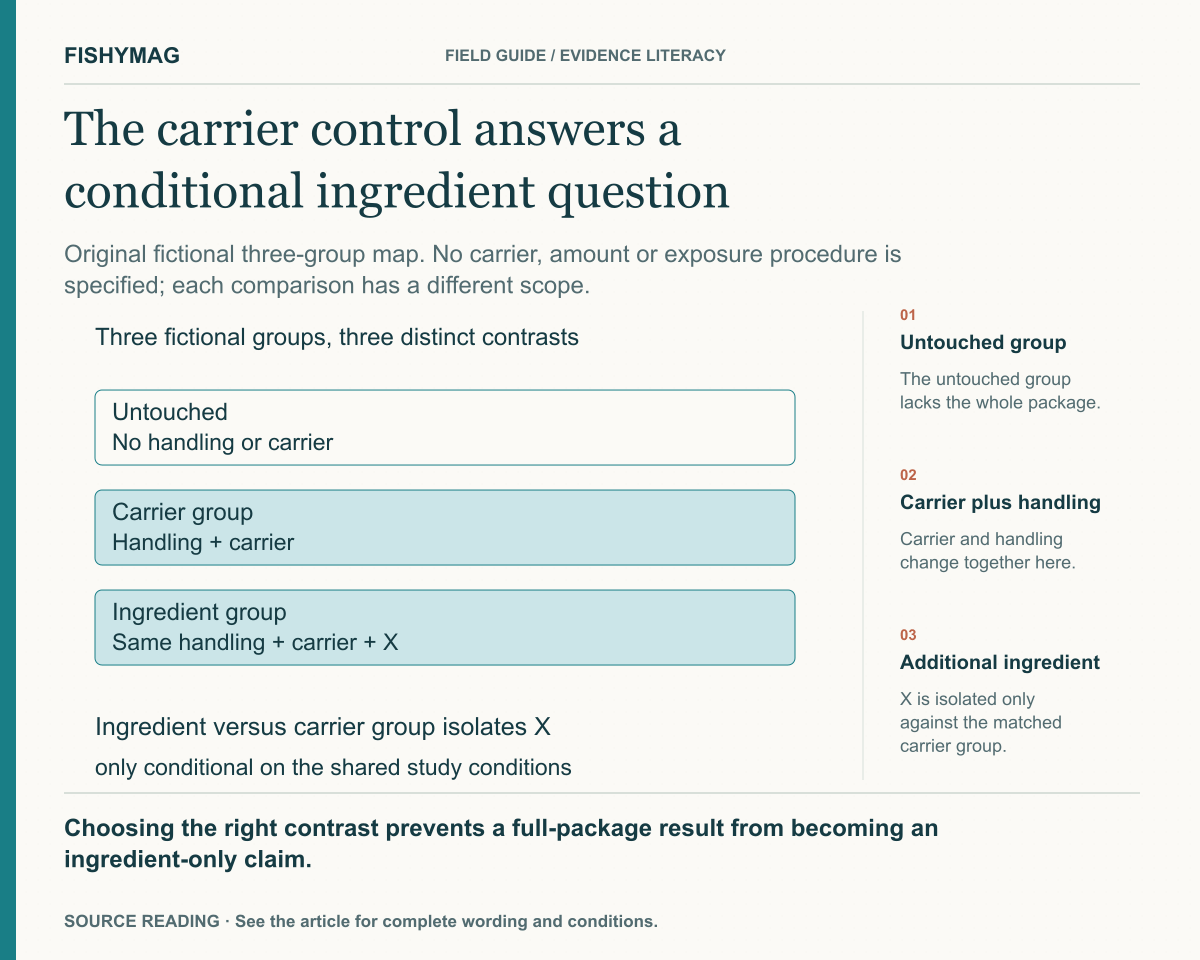
Figure data and explanation
Original fictional three-group map. No carrier, amount or exposure procedure is specified; each comparison has a different scope.
- Untouched group
- The untouched group lacks the whole package.
- Carrier plus handling
- Carrier and handling change together here.
- Additional ingredient
- X is isolated only against the matched carrier group.
Choosing the right contrast prevents a full-package result from becoming an ingredient-only claim.
Use the control that answers the specific question
The fictional record includes three groups: untouched; handled with carrier only; and identically handled with the same carrier plus ingredient X. No carrier identity, amount or administration procedure is provided. ARRIVE’s group-and-control reporting principles help recover these definitions. The completed contrast map below is original editorial reasoning about that record.
Name every pairwise comparison
The carrier group is useful for one contrast without answering every other question. In particular, it does not separate handling from the carrier because those two features change together against the untouched group.
| Comparison | Features held shared | Features changing | Question represented |
|---|---|---|---|
| Carrier group versus untouched | Endpoint definition and study window stipulated | Handling plus carrier | Combined carrier-and-handling difference |
| Ingredient group versus carrier group | Handling and carrier stipulated identical | Ingredient X | Additional X under those shared conditions |
| Ingredient group versus untouched | Endpoint definition and study window stipulated | Handling, carrier and X | Full package difference |
| Handling alone versus untouched | No corresponding group supplied | Not isolated | Unresolved |
| Ingredient without carrier | No corresponding group supplied | Not observed | Do not transfer the conditional contrast |
Keep a conditional result conditional
Even a well-defined ingredient contrast concerns the endpoint, exposure context and observation period actually assessed. It cannot by itself clear a commercial formulation, a different carrier or every aquarium inhabitant. Conversely, a difference in the carrier-versus-untouched comparison cannot be assigned wholly to the carrier when handling also differs. Preserve the full three-group definition with any effect estimate and ask for the particular missing comparison if a summary goes beyond it. This map helps read an existing study; it is not a proposal to conduct animal exposures at home.
Use your own details
Which aquarium control isolates the named ingredient? worksheet
Download the editable text file, fill it in on your device and keep it with the relevant record. This blank worksheet records your information; it does not verify entries or approve treatment.
- Untouched group definition
- Carrier-only group definition
- Ingredient-group definition
- Handling matched between which groups
- Carrier matched between which groups
- Endpoint and time window
- Each pairwise contrast and its scope
- Unseparated factors and missing evidence
Put it into practice
Your checklist
- Define the control for the claim being evaluated.
- List the changing factors in all three contrasts.
- Retain the shared-carrier condition in ingredient-only wording.
Sources and scope
This article distinguishes manufacturer statements from FishyMag’s own workflows and arithmetic examples. Linked formulation records retain their own evidence dates; publishing this article does not refresh those records.
AI-assisted writing and development. Not hands-on product testing or veterinary review. How we publish →
FishyMag reports what manufacturers say, quoted and linked. It does not diagnose illness or recommend a treatment, and it never infers that a product is safe from the absence of a warning — where no statement exists, it says so.
Formulations change. Always read the label on the bottle in your hand, and contact the manufacturer if your tank contains anything valuable or unusual.