Keeper workflows
Aquarium carbon: capacity is not removal speed
Separate carbon loading per gram from an initial removal rate and decide which evidence supports each claim.
By FishyMag · Published
Worked filtration evidence example · Not a clinical review or treatment recommendation.
Quick answer
In the worked record, 6 mg on 2 g of carbon is 3 mg/g under the stated conditions. An initial rate of 0.4 mg/min answers a different question. The record cannot show how long removal continues or when the water reaches any specified concentration.
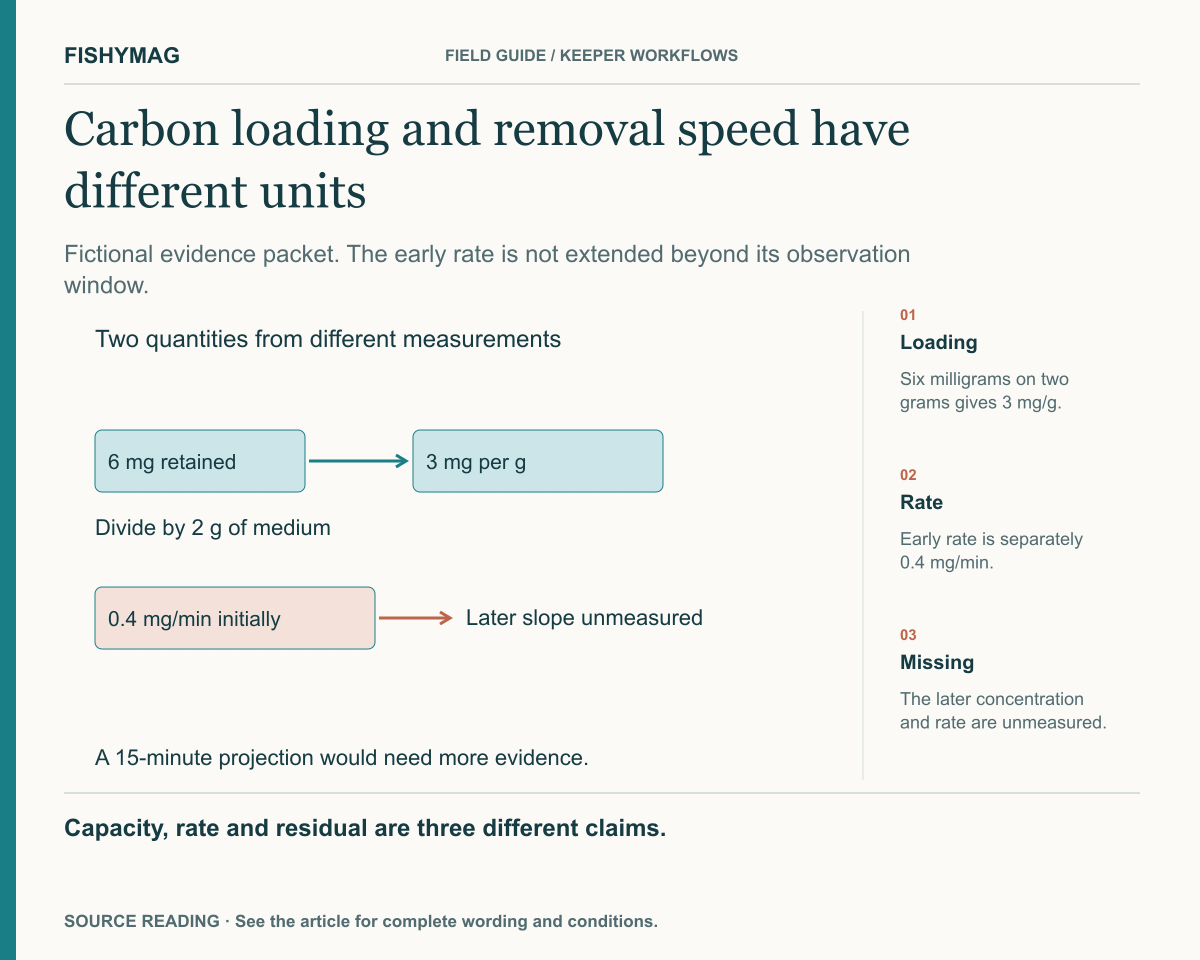
Figure data and explanation
Fictional evidence packet. The early rate is not extended beyond its observation window.
- Loading
- Six milligrams on two grams gives 3 mg/g.
- Rate
- Early rate is separately 0.4 mg/min.
- Missing
- The later concentration and rate are unmeasured.
Capacity, rate and residual are three different claims.
Read the capacity and time records separately
The fictional dataset has a carbon mass of 2 g dry basis and 6 mg of identified compound X recovered from it at the reported endpoint. A separate early-time calculation reports an initial 0.4 mg/min rate. The published date-palm carbon study treats oil uptake over time and fitted equilibrium separately in simulated seawater. Its materials and analyte are different from this example; no oil-removal result transfers to a treatment residue.
Use the right denominator for the claim
Three milligrams per gram is the observed loading in this case. It is not automatically a maximum or saturation capacity.
| Record | Result | Limit |
|---|---|---|
| Recovered mass per dry carbon mass | 6 ÷ 2 = 3 mg/g | Applies at the sampled endpoint |
| Initial removal rate | 0.4 mg/min | Applies only to the early interval |
| Constant-rate extrapolation | 6 ÷ 0.4 = 15 min | Requires an unshown constant rate and a defined target inventory |
| Final water residual | No applicable late water result | Unknown |
Ask for the missing result that matches your question
If the question is whether the outlet remains below a reporting level after a certain throughput, a late inlet and outlet series is more relevant than another equilibrium capacity estimate. If the question is whether a fitted rate applies to a different matrix, ask for a comparable time course and method. Retained mass alone does not establish absence in the water or the performance of any aquarium medium.
Use your own details
Aquarium carbon: capacity is not removal speed worksheet
Download the editable text file, fill it in on your device and keep it with the relevant record. This blank worksheet records your information; it does not verify entries or approve treatment.
- Target and analytical fraction
- Carbon identity and mass basis
- Water matrix and test conditions
- Time interval for each measurement
- Mass retained and its denominator
- Early time series and rate fit
- Later residual or breakthrough evidence
Put it into practice
Your checklist
- State the carbon mass basis and analyte.
- Record the exact interval for the reported rate.
- Require separate data before projecting late residual or time.
Sources and scope
This article distinguishes manufacturer statements from FishyMag’s own workflows and arithmetic examples. Linked formulation records retain their own evidence dates; publishing this article does not refresh those records.
- Experimental adsorption of engine oil from simulated seawater with date-palm activated carbon; reviewed November 9, 2026 ↗
- EPA verification protocol for organic contaminant removal; reviewed November 9, 2026 ↗
AI-assisted writing and development. Not hands-on product testing or veterinary review. How we publish →
FishyMag reports what manufacturers say, quoted and linked. It does not diagnose illness or recommend a treatment, and it never infers that a product is safe from the absence of a warning — where no statement exists, it says so.
Formulations change. Always read the label on the bottle in your hand, and contact the manufacturer if your tank contains anything valuable or unusual.