Keeper workflows
Does the aquarium supply certificate cover this batch?
Check a batch certificate against the received item and distinguish a stated conformance claim from the specific analytical results actually supplied.
By FishyMag · Published
Worked evidence example · Not a clinical review or treatment recommendation.
Quick answer
Match the product and lot before assigning a certificate’s values to a received bottle. In this fictional packet, both documents name REF-1, but the bottle is lot P8 and the supplied certificate is for P7. The product-family match cannot bridge the batch mismatch. A separate conformance letter supplies no missing P8 analytical result.
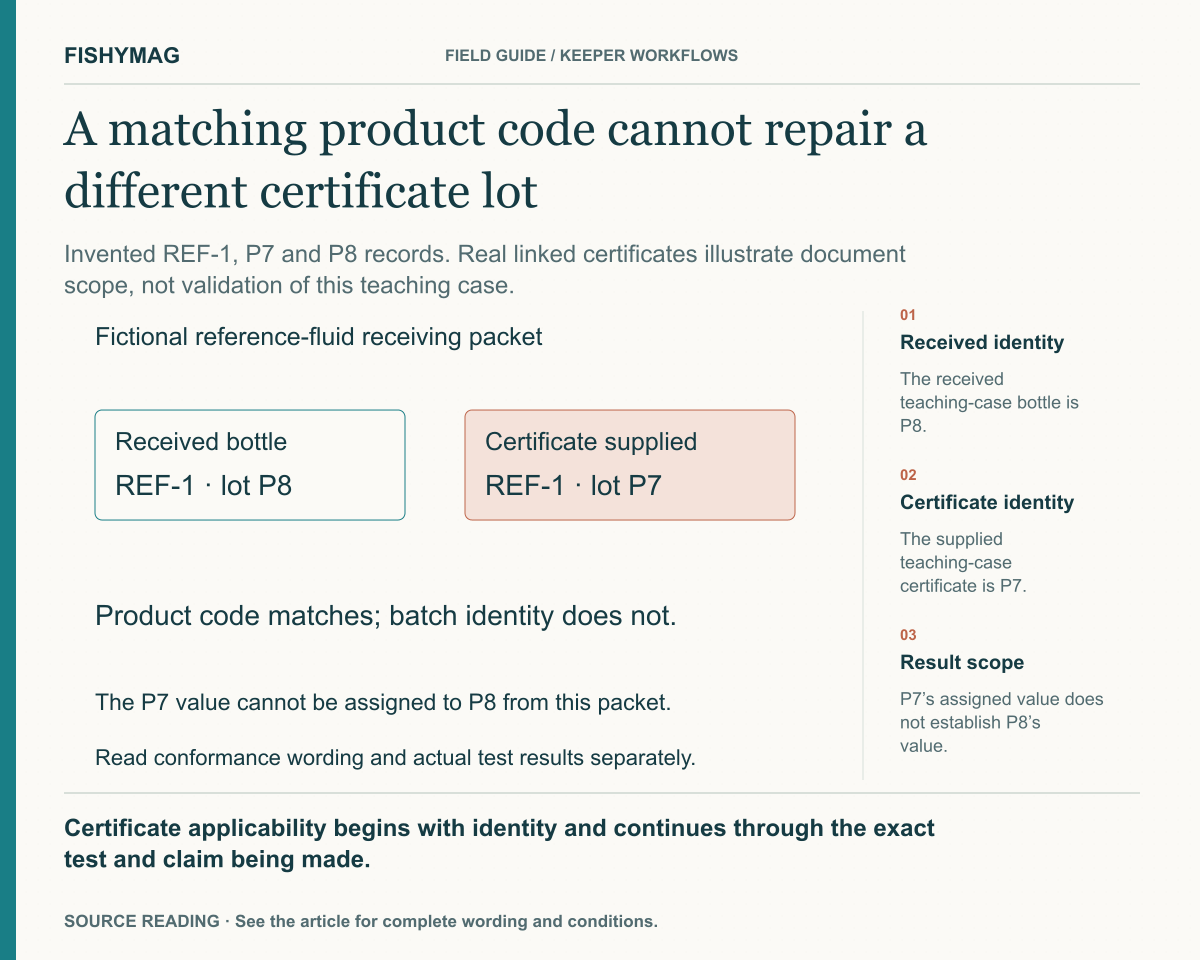
Figure data and explanation
Invented REF-1, P7 and P8 records. Real linked certificates illustrate document scope, not validation of this teaching case.
- Received identity
- The received teaching-case bottle is P8.
- Certificate identity
- The supplied teaching-case certificate is P7.
- Result scope
- P7’s assigned value does not establish P8’s value.
Certificate applicability begins with identity and continues through the exact test and claim being made.
A certificate’s own identity fields matter
The real Thermo Fisher certificate linked below names a particular ORP solution and lot and has an expiry of May 4, 2026. It is a historical example of a document with specific scope, not current reference evidence for use. Hanna’s HI713-11 instructions also identify a certificate as part of a particular checking kit. Neither source supports attaching any certificate from a product family to an arbitrary received batch. The REF-1 packet below is entirely invented and is not a reproduction of either manufacturer’s certificate.
Complete the received-batch decision
The invented bottle names REF-1 and lot P8. The certificate names REF-1 and lot P7, with an assigned nitrate value of 10.00 mg/L as N. That numerical value is a teaching-case certificate entry, not a FishyMag measurement or a real manufacturer specification.
| Check | Packet evidence | Finding |
|---|---|---|
| Product identity | REF-1 on bottle and certificate | Code match retained |
| Batch identity | P8 received; P7 certified | Known mismatch |
| Assigned value | 10.00 mg/L as N on P7 certificate | Cannot be assigned to P8 from this packet |
| Explicit cross-batch applicability | None supplied | No bridge established |
| Current bottle validity | P8 document not supplied | No certificate-based validation issued |
Read a conformance statement without inventing assay data
A separate fictional letter says only that REF-1 was manufactured to the supplier’s specification. It contains no P8 lot identifier, numerical result or test method. Preserve exactly that conformance claim; do not rewrite it as a batch assay. Document titles alone are not decisive: a conformance certificate can contain test data, and a document called an analysis certificate can still omit the field the question needs. Read the actual contents and issuer scope.
Request the missing document, then review its test coverage
Ask for the document applicable to P8 or an explicit, substantiated applicability statement. Once obtained, check which quantities and methods it actually covers, along with conditions, uncertainty, expiry and acceptance criteria. An assigned nitrate value would not independently establish every contaminant’s absence, animal compatibility or suitability for a treatment. A matching lot is necessary for this packet’s proposed batch claim, but it is not a universal guarantee of the whole measurement chain. Keep the mismatched P7 document as evidence of what was received rather than silently replacing its lot in a spreadsheet.
Use your own details
Does the aquarium supply certificate cover this batch? worksheet
Download the editable text file, fill it in on your device and keep it with the relevant record. This blank worksheet records your information; it does not verify entries or approve treatment.
- Received product, market, lot and expiry
- Certificate issuer, source and document identifier
- Product and lot named inside the certificate
- Actual tests, methods, results and quantity bases supplied
- Conditions, uncertainty and acceptance criteria actually stated
- Separate conformance wording and its scope
- Completed bottle-to-certificate applicability finding
- Missing batch-specific document or explicit applicability bridge
Put it into practice
Your checklist
- Match the certificate’s product and lot to the received item.
- Read conformance wording separately from supplied numerical results.
- Assess actual test coverage after the identity link is established.
Sources and scope
This article distinguishes manufacturer statements from FishyMag’s own workflows and arithmetic examples. Linked formulation records retain their own evidence dates; publishing this article does not refresh those records.
- Thermo Fisher product 042131, lot R04H007 certificate of analysis; expired May 4, 2026; reviewed November 9, 2026 ↗
- Hanna HI713-11 instruction guide, IST713-11 12/20; reviewed November 8, 2026 ↗
- FishyMag evidence methodology; reviewed November 8, 2026 ↗
- FishyMag bottle identity worksheet; reviewed November 8, 2026 ↗
- FishyMag manufacturer question brief; reviewed November 8, 2026 ↗
AI-assisted writing and development. Not hands-on product testing or veterinary review. How we publish →
FishyMag reports what manufacturers say, quoted and linked. It does not diagnose illness or recommend a treatment, and it never infers that a product is safe from the absence of a warning — where no statement exists, it says so.
Formulations change. Always read the label on the bottle in your hand, and contact the manufacturer if your tank contains anything valuable or unusual.