Keeper workflows
An aquarium alert setting is not a measurement guarantee
Separate a fictional alert margin from display resolution, a real monitor’s accuracy specification and the actual timing or safety of an alarm.
By FishyMag · Published
Worked arithmetic example · Not a clinical review or treatment recommendation.
Quick answer
A displayed 27.90 °C is 0.10 °C below the fictional 28.00 °C alert setting. That subtraction does not establish the actual water temperature, an alarm’s timing or livestock safety. Resolution, measurement performance and the alert rule answer different questions.
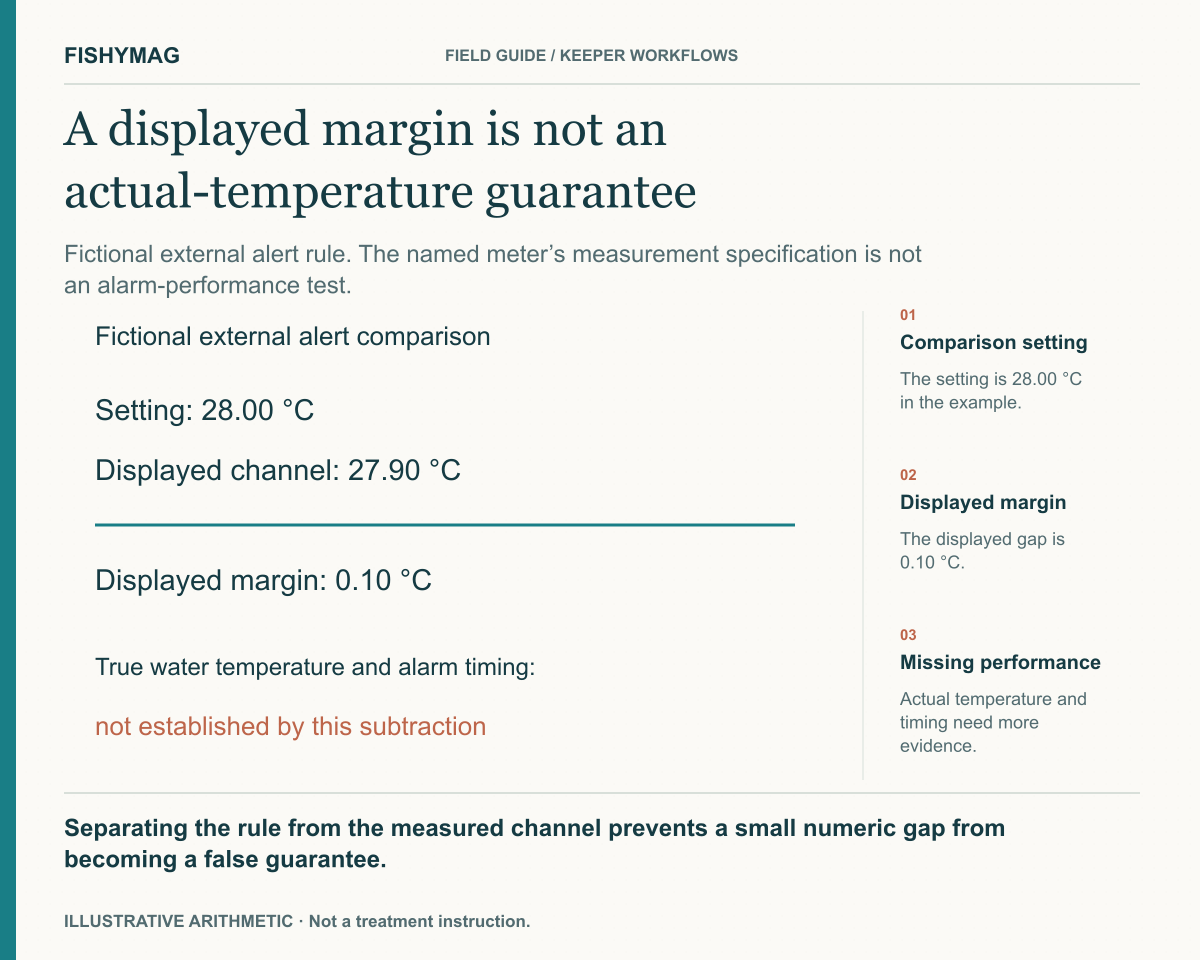
Figure data and explanation
Fictional external alert rule. The named meter’s measurement specification is not an alarm-performance test.
- Comparison setting
- The setting is 28.00 °C in the example.
- Displayed margin
- The displayed gap is 0.10 °C.
- Missing performance
- Actual temperature and timing need more evidence.
Separating the rule from the measured channel prevents a small numeric gap from becoming a false guarantee.
Keep the alert rule separate from the measuring instrument
This example uses a fictional external alert rule; it does not claim that the selected Hanna meter implements that alarm. The HI98194-family manual lists temperature resolution of 0.01 °C and accuracy of ±0.15 °C. A resolution entry is not a complete uncertainty assessment, and a catalogue accuracy statement needs its applicable conditions.
Complete the evidence table
The two decimal places are retained so the arithmetic is transparent. The setting is an illustration, not a temperature recommendation.
| Field | Evidence | Supported finding |
|---|---|---|
| Alert setting | Fictional 28.00 °C rule | A comparison value, not a livestock limit |
| Displayed channel | 27.90 °C | 0.10 °C below the stated setting |
| Resolution | Manual lists 0.01 °C | Display increment, not actual accuracy |
| Accuracy specification | Manual lists ±0.15 °C | Performance statement with its scope |
| Alarm timing | Rule, averaging and delivery details absent | Not established |
| Actual water temperature | No complete sample-specific measurement assessment | Not inferred from display margin alone |
Retain the dependencies that could change the interpretation
A real alarm record needs the channel’s processing, sampling and rule semantics, plus its notification path. An alert can also be delayed or unavailable independently of the displayed margin. This worksheet records those distinct questions without proposing a tighter setting, a safety boundary or an equipment adjustment.
Use your own details
An aquarium alert setting is not a measurement guarantee worksheet
Download the editable text file, fill it in on your device and keep it with the relevant record. This blank worksheet records your information; it does not verify entries or approve treatment.
- Fictional versus actual alert rule
- Monitored channel and sensor location
- Displayed number and observation time
- Display resolution
- Applicable accuracy statement and conditions
- Processing, interval and notification path
- Displayed margin only
- Actual-temperature and timing questions still open
Put it into practice
Your checklist
- Call the subtraction a displayed margin.
- Keep resolution and accuracy separate.
- Do not infer alarm timing or animal safety from a threshold gap.
Sources and scope
This article distinguishes manufacturer statements from FishyMag’s own workflows and arithmetic examples. Linked formulation records retain their own evidence dates; publishing this article does not refresh those records.
- Hanna HI98194/HI98195/HI98196 instruction manual; reviewed November 9, 2026 ↗
- NIST TN1297 Appendix D1: measurement terminology; reviewed November 8, 2026 ↗
AI-assisted writing and development. Not hands-on product testing or veterinary review. How we publish →
FishyMag reports what manufacturers say, quoted and linked. It does not diagnose illness or recommend a treatment, and it never infers that a product is safe from the absence of a warning — where no statement exists, it says so.
Formulations change. Always read the label on the bottle in your hand, and contact the manufacturer if your tank contains anything valuable or unusual.