Keeper workflows
Work through an aquarium alarm’s delay and reset rules
Calculate a complete synthetic alarm timeline from explicit continuous-delay and latch rules, then identify which actual-controller semantics cannot be assumed.
By FishyMag · Published
Worked arithmetic example · Not a clinical review or treatment recommendation.
Quick answer
In the declared synthetic rule, the alarm activates at 100 seconds after 30 uninterrupted seconds of TRUE input. It remains active after recovery at 110 seconds and clears at the eligible manual reset at 140 seconds. These are explicitly defined teaching rules, not a claimed implementation or suggested setting for a real controller.
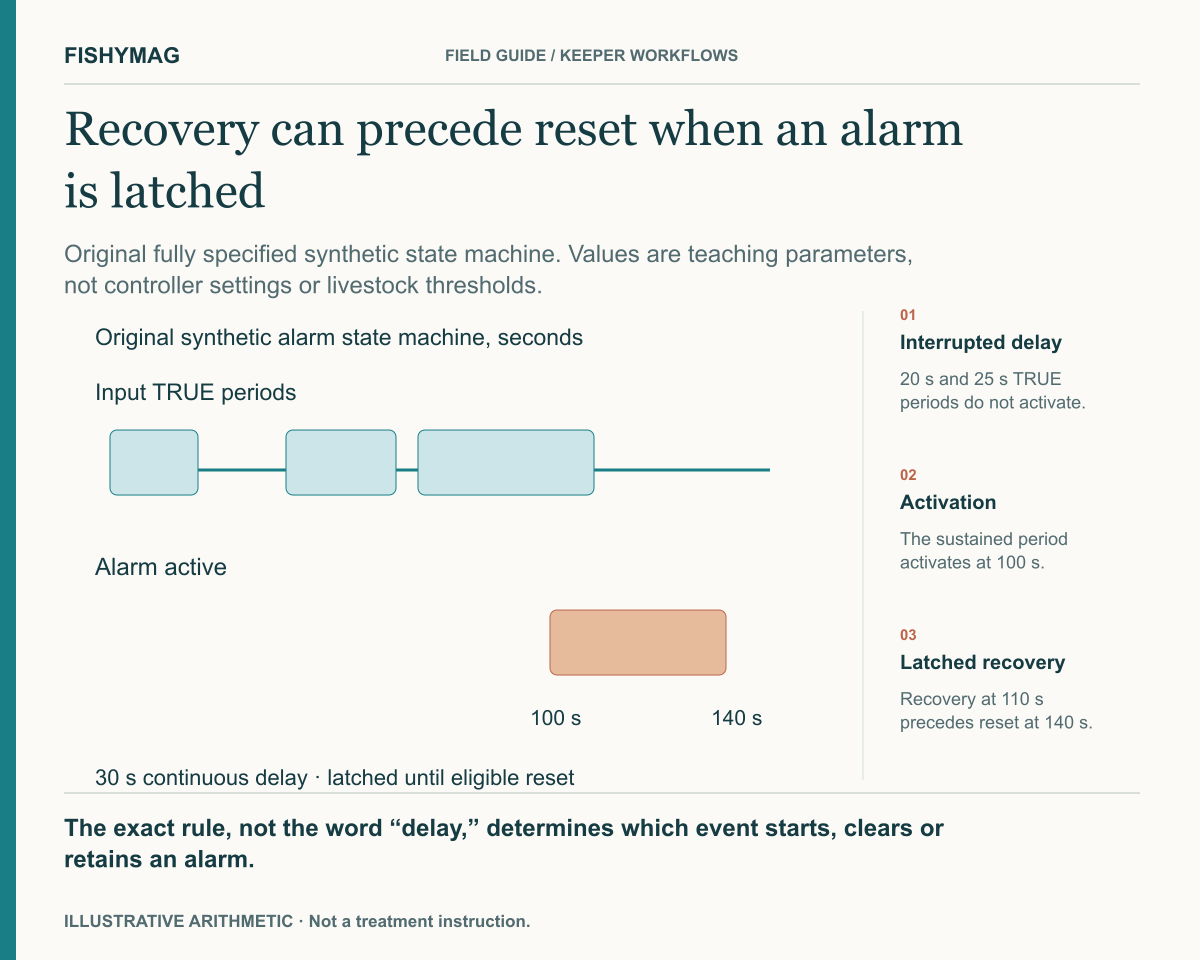
Figure data and explanation
Original fully specified synthetic state machine. Values are teaching parameters, not controller settings or livestock thresholds.
- Interrupted delay
- 20 s and 25 s TRUE periods do not activate.
- Activation
- The sustained period activates at 100 s.
- Latched recovery
- Recovery at 110 s precedes reset at 140 s.
The exact rule, not the word “delay,” determines which event starts, clears or retains an alarm.
Declare the rules before calculating a time
The input below is a fully specified synthetic Boolean trace, not intermittent observations of an aquarium. TRUE must persist for 30 continuous seconds; FALSE clears a pending delay. Once active, the alarm latches through recovery and clears only on a manual reset while the input is FALSE. The example controls an alert state only. It does not operate aquarium equipment.
Calculate the full trace
The first two TRUE periods are shorter than the defined delay. The third begins at 70 seconds, so activation occurs at 70 + 30 = 100. Recovery at 110 does not clear the latched alarm.
| Time or interval | Declared input/event | Calculated alarm state |
|---|---|---|
| 0 to 20 s | TRUE for 20 s | Inactive; pending delay ends on FALSE |
| 20 to 40 s | FALSE | Inactive; timer cleared |
| 40 to 65 s | TRUE for 25 s | Inactive; interrupted delay |
| 65 to 70 s | FALSE | Inactive; timer cleared |
| 70 to 100 s | TRUE, continuous delay | Inactive until the defined 30 s boundary |
| 100 to 110 s | TRUE | Active |
| 110 to 140 s | FALSE after recovery | Still active because latched |
| 140 s | Manual reset while FALSE | Cleared |
Do not transfer the teaching rules into a real device
The GHL resource guide illustrates that level-alarm behavior can differ with automatic versus manual reset configuration. It is not documentation of the synthetic timer above. For an actual installation, recover the firmware’s activation, timer interruption, equality, acknowledgement and reset rules. Where a rule is undocumented, the affected time remains indeterminate. A silenced notification must not be assumed to clear a latched condition.
Use your own details
Work through an aquarium alarm’s delay and reset rules worksheet
Download the editable text file, fill it in on your device and keep it with the relevant record. This blank worksheet records your information; it does not verify entries or approve treatment.
- Actual firmware and rule documentation
- Input meaning and interval evidence
- Activation comparison including equality
- Continuous versus cumulative delay
- Pending-timer reset behavior
- Latched versus automatic recovery
- Acknowledgement versus eligible reset
- Computed teaching trace versus actual-controller evidence
Worked example files
These files contain the article’s worked example. Read its source and scope notes, and keep your own current records before opening an example in a tool.
Put it into practice
Your checklist
- Write every state rule before calculating transitions.
- Separate recovery, acknowledgement and reset.
- Keep undocumented real-device timing indeterminate.
Sources and scope
This article distinguishes manufacturer statements from FishyMag’s own workflows and arithmetic examples. Linked formulation records retain their own evidence dates; publishing this article does not refresh those records.
- GHL ProfiLux4/4e GHL Connect resource guide, June2020; reviewed November 9, 2026 ↗
- Australian and New Zealand guidelines: water-quality data analysis; reviewed November 8, 2026 ↗
AI-assisted writing and development. Not hands-on product testing or veterinary review. How we publish →
FishyMag reports what manufacturers say, quoted and linked. It does not diagnose illness or recommend a treatment, and it never infers that a product is safe from the absence of a warning — where no statement exists, it says so.
Formulations change. Always read the label on the bottle in your hand, and contact the manufacturer if your tank contains anything valuable or unusual.