Keeper workflows
Where did the aquarium chemical go?
Separate water-only disappearance, material association and measured transformation products in an aquarium evidence record.
By FishyMag · Published
Worked formulation evidence example · Not a clinical review or treatment recommendation.
Quick answer
A lower parent result in water shows a decline in that measured fraction. Recovering parent on a material shows association but not whether it sits on the surface or in the material. A verified transformation product shows some conversion, without accounting for every missing parent molecule.

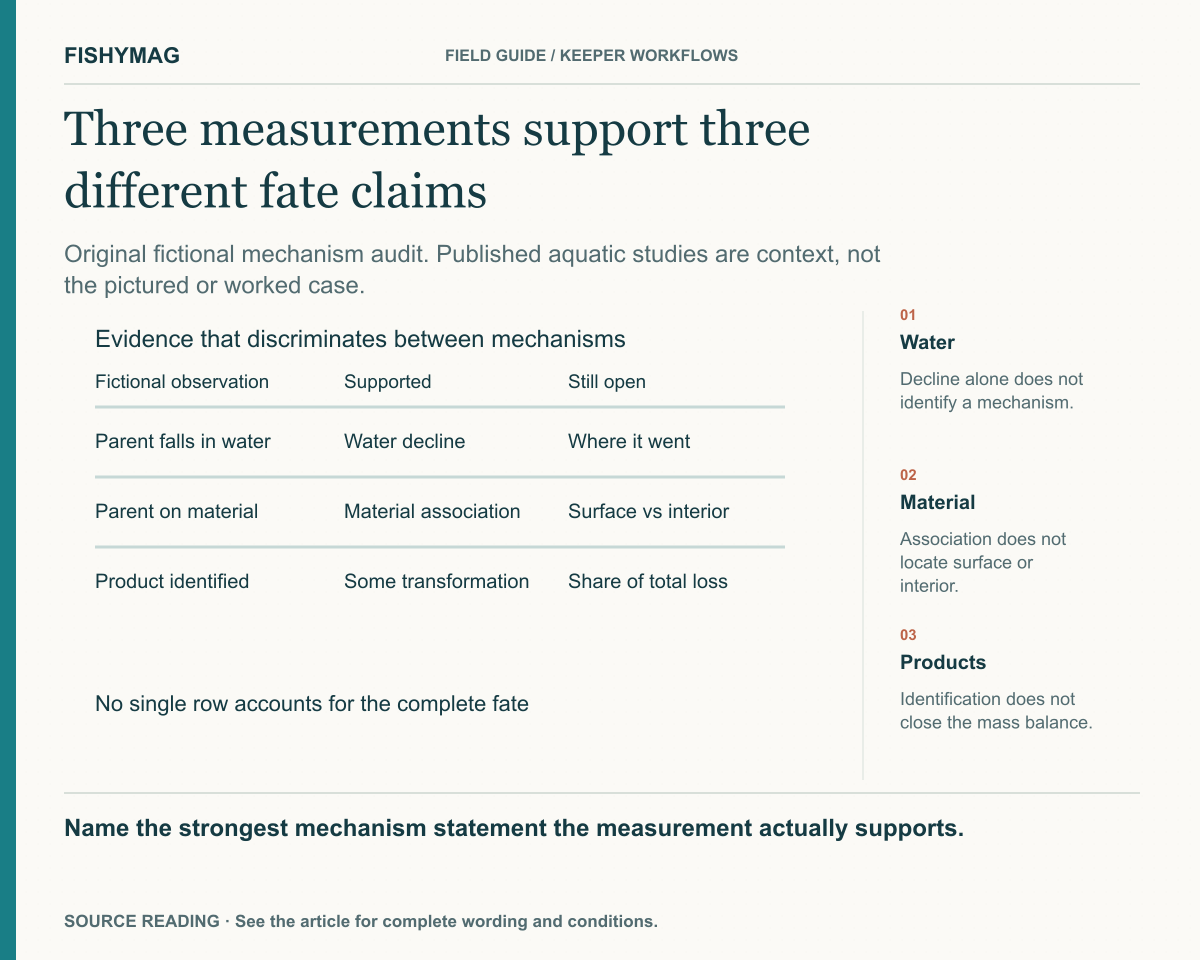
Figure data and explanation
Original fictional mechanism audit. Published aquatic studies are context, not the pictured or worked case.
- Water
- Decline alone does not identify a mechanism.
- Material
- Association does not locate surface or interior.
- Products
- Identification does not close the mass balance.
Name the strongest mechanism statement the measurement actually supports.
Look for compartments that distinguish competing explanations
A marine-aquarium praziquantel study followed parent concentration in water and compared established systems with sterilised conditions. The different patterns bear on a biological contribution in its setup. They do not quantify every surface or product. A separate aquaculture field study sampled water and sediment, illustrating how a second compartment can add evidence without resolving the whole mechanism.
Classify three observations in a separate fictional dossier
The material assay here combines surface and interior extracts. The product identification is stipulated as verified by a suitable comparison. Neither observation gives a whole-system balance.
| Observation | Supports | Would need more evidence for |
|---|---|---|
| Parent declines in water only | Lower measured parent in that fraction | Adsorption, uptake, reaction or another fate |
| Parent recovered with the material | Material association | A validated split of surface and interior to distinguish adsorption from absorption |
| Specific product verified after change | Some transformation in the case | Molar accounting and controls for the fraction transformed |
Ask which missing measurement would resolve the mechanism
If the report recovers a compound with substrate but does not separate its surface from its interior, use “material-associated” in the summary. If the study has a product identification but no quantitation, do not allocate a percentage of the parent decline to that path. These distinctions help read studies; they do not prescribe a treatment or cleanup method.
Use your own details
Where did the aquarium chemical go? worksheet
Download the editable text file, fill it in on your device and keep it with the relevant record. This blank worksheet records your information; it does not verify entries or approve treatment.
- Parent compound and water result
- Control or comparison condition
- Material sample and recovery basis
- Surface and interior fractions separated?
- Transformation product identification basis
- Other possible routes and mass coverage
- Next measurement that would discriminate mechanisms
Put it into practice
Your checklist
- Record which compartments were sampled.
- Distinguish material association from where the material holds the compound.
- Keep transformation identification separate from complete mass accounting.
Sources and scope
This article distinguishes manufacturer statements from FishyMag’s own workflows and arithmetic examples. Linked formulation records retain their own evidence dates; publishing this article does not refresh those records.
- Praziquantel degradation in marine aquarium water; reviewed November 9, 2026 ↗
- Primary preliminary praziquantel monitoring in water and sediment at a Japanese aquaculture site; reviewed November 9, 2026 ↗
- FishyMag evidence methodology; reviewed November 8, 2026 ↗
AI-assisted writing and development. Not hands-on product testing or veterinary review. How we publish →
FishyMag reports what manufacturers say, quoted and linked. It does not diagnose illness or recommend a treatment, and it never infers that a product is safe from the absence of a warning — where no statement exists, it says so.
Formulations change. Always read the label on the bottle in your hand, and contact the manufacturer if your tank contains anything valuable or unusual.