Keeper workflows
The active ingredient and its salt are not the same mass
Compare a stated mass of doxycycline hyclate with an already converted active-equivalent result.
By FishyMag · Published
Worked formulation evidence example · Not a clinical review or treatment recommendation.
Quick answer
In the fictional pure-hyclate assay, 102.588 mg corresponds to 88.886 mg anhydrous doxycycline equivalent. The other record already reports 90 mg on that equivalent basis. Apply no second correction to it, and do not infer bottle contents from either formula.
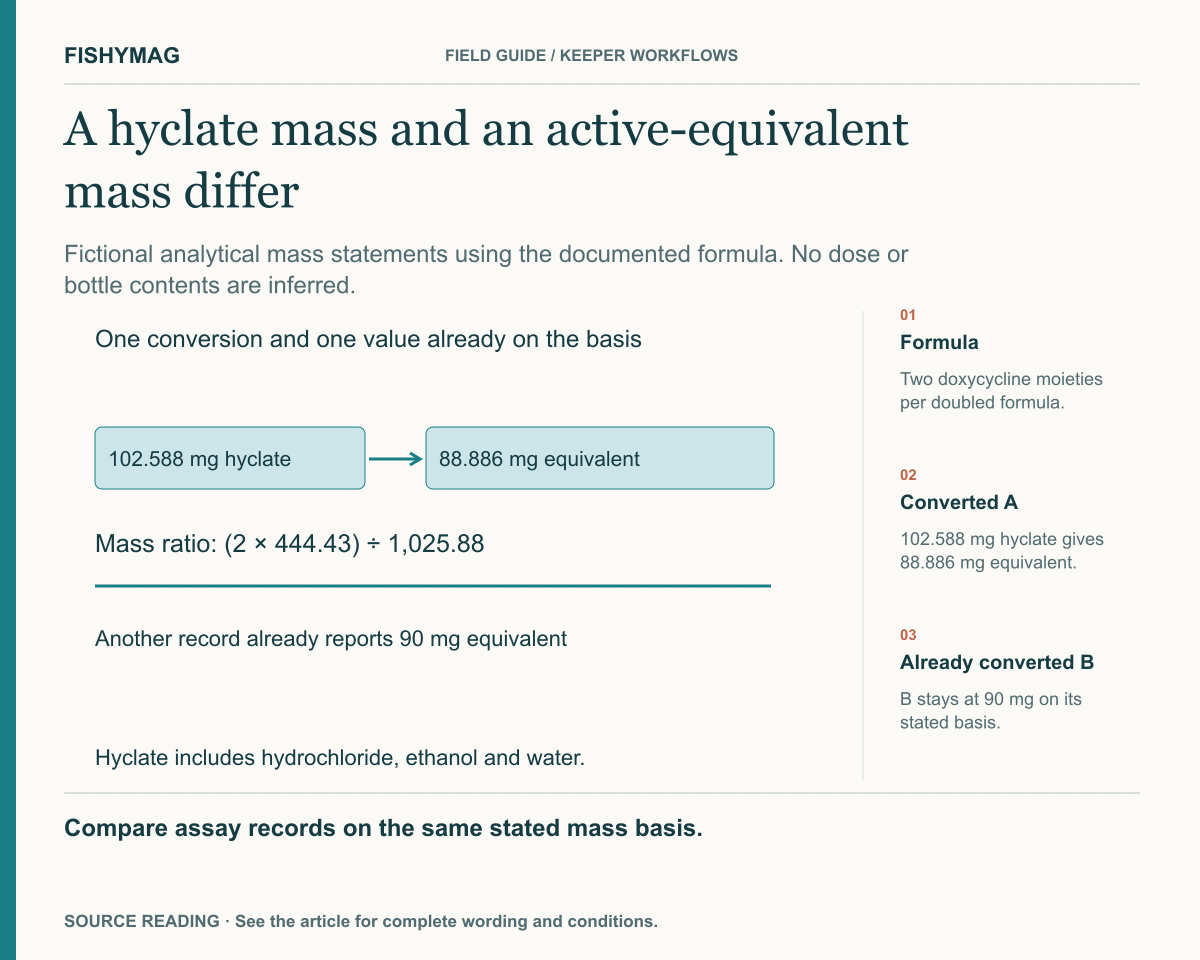
Figure data and explanation
Fictional analytical mass statements using the documented formula. No dose or bottle contents are inferred.
- Formula
- Two doxycycline moieties per doubled formula.
- Converted A
- 102.588 mg hyclate gives 88.886 mg equivalent.
- Already converted B
- B stays at 90 mg on its stated basis.
Compare assay records on the same stated mass basis.
Start with the labelled chemical form
The DailyMed hyclate label describes (C₂₂H₂₄N₂O₈·HCl)₂·C₂H₆O·H₂O with formula mass 1,025.88 g/mol. Its doubled formula contains two doxycycline moieties, plus hydrochloride, ethanol and water. The separate monohydrate label gives 462.45 g/mol for one doxycycline with one water; subtracting about 18.02 g/mol gives approximately 444.43 g/mol for the anhydrous moiety. The label structure drawings identify the compound. Equal formula mass alone would not establish stereochemical identity.
Convert only the record that gives hyclate mass
Both reports below are fictional mass statements, not product strengths or amounts to administer. A is stipulated as pure hyclate on the stated formula basis.
| Record | Stated basis | Anhydrous doxycycline basis |
|---|---|---|
| A | 102.588 mg hyclate | 102.588 × (2 × 444.43 / 1,025.88) = 88.886 mg equivalent |
| B | 90 mg anhydrous equivalent | 90 mg already on the comparison basis |
| Ambiguous report | Doxycycline compound, no form or basis | Cannot convert reliably |
Do not subtract counterions from an already converted label
The actual hyclate capsule label expresses strength as an anhydrous equivalent. That wording is an instruction for reading its mass basis, not for recalculating it again. A bulk material with a different hydration state, purity or assay definition would require different evidence. This comparison is not an aquarium dose, a substitution or a livestock claim.
Use your own details
The active ingredient and its salt are not the same mass worksheet
Download the editable text file, fill it in on your device and keep it with the relevant record. This blank worksheet records your information; it does not verify entries or approve treatment.
- Chemical form and exact formula
- Counterion, solvate and hydration state
- Molar mass and active units per formula unit
- Assay denominator and purity basis
- Whether active equivalence is already stated
- Common equivalent result with rounding
- Unresolved label or batch identity
Put it into practice
Your checklist
- Identify the complete salt, solvate and hydration basis.
- Count active moieties per stated formula unit.
- Avoid reconverting a value already expressed as an active equivalent.
Sources and scope
This article distinguishes manufacturer statements from FishyMag’s own workflows and arithmetic examples. Linked formulation records retain their own evidence dates; publishing this article does not refresh those records.
- DailyMed doxycycline hyclate capsule label, description; reviewed November 9, 2026 ↗
- DailyMed doxycycline monohydrate label, description; reviewed November 9, 2026 ↗
- FishyMag evidence methodology; reviewed November 8, 2026 ↗
AI-assisted writing and development. Not hands-on product testing or veterinary review. How we publish →
FishyMag reports what manufacturers say, quoted and linked. It does not diagnose illness or recommend a treatment, and it never infers that a product is safe from the absence of a warning — where no statement exists, it says so.
Formulations change. Always read the label on the bottle in your hand, and contact the manufacturer if your tank contains anything valuable or unusual.