Keeper workflows
Make an aquarium handover readable without colour or a screenshot
Convert a compact aquarium table into a labelled reading sequence that retains its result, unit, method gap and action status. Includes a worked text example.
By FishyMag · Published
FishyMag editorial workflow · Not a clinical review or treatment recommendation.
Quick answer
Write the system identity first, then give each record a labelled value, unit, method, status and reason. Do not rely on colour, column position or a screenshot to carry the meaning. Keep a table’s headers associated with its cells and provide the essential meaning of a diagram in text.

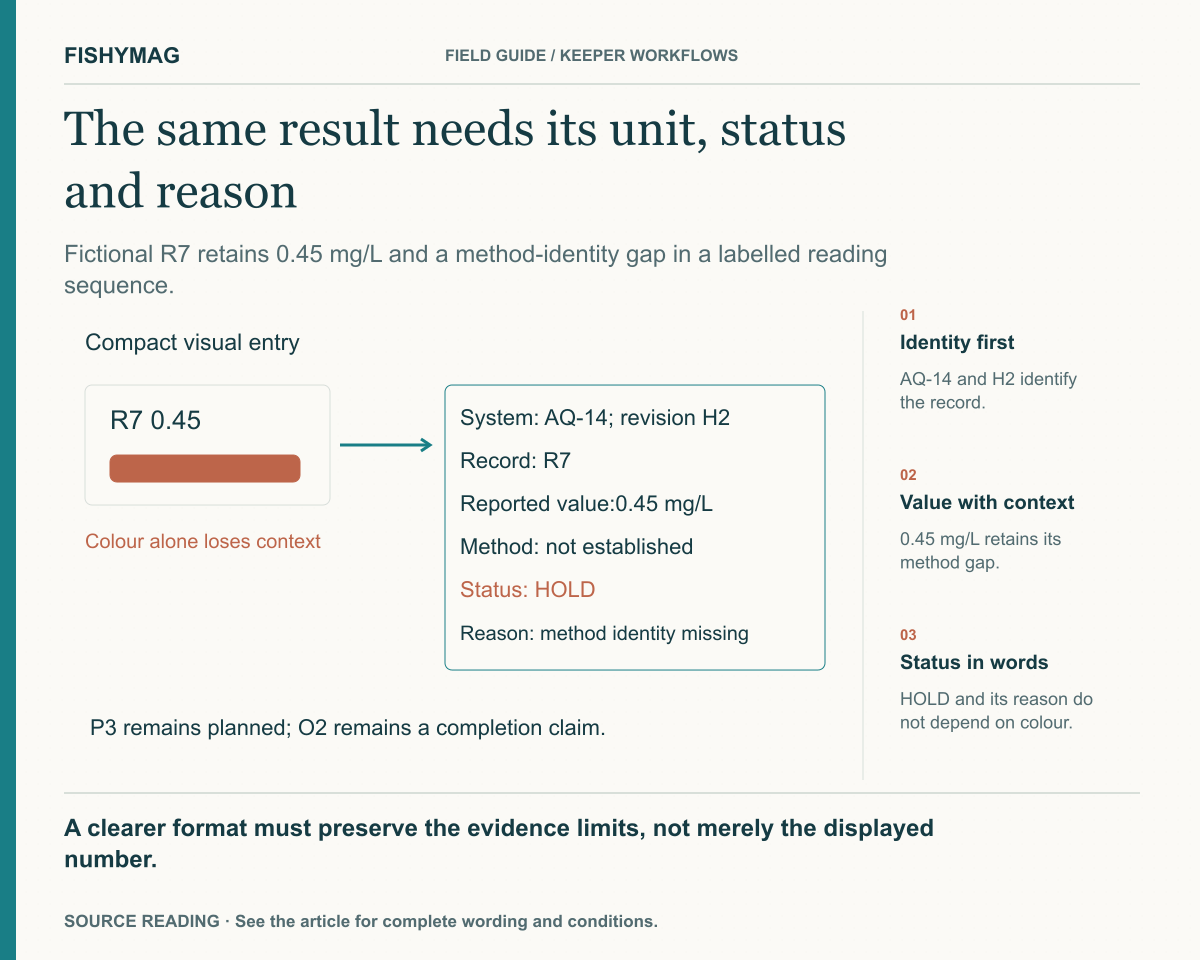
Figure data and explanation
Fictional R7 retains 0.45 mg/L and a method-identity gap in a labelled reading sequence.
- Identity first
- AQ-14 and H2 identify the record.
- Value with context
- 0.45 mg/L retains its method gap.
- Status in words
- HOLD and its reason do not depend on colour.
A clearer format must preserve the evidence limits, not merely the displayed number.
Preserve meaning before changing presentation
A coloured row marked only by a red fill loses its status when read without that visual cue. A screenshot can also separate a result from the context needed to interpret it. W3C’s table guidance explains the role of structural header relationships; its complex-image guidance calls for an essential text equivalent alongside a short description. These are presentation principles. They do not turn a handover into verified evidence or establish accessibility for every device.
Worked case: one result and one planned question
AQ-14 and every entry below are fictional. The original compact row places 0.45 under a column headed mg/L and uses colour to mean a hold. The rewrite carries the same information into labelled text and adds an explicit statement where the source already lacks a method identity. It does not supply that missing method.
| Original element | Labelled version | Meaning preserved |
|---|---|---|
| Table heading: AQ-14,H2 | System:AQ-14; revision:H2 | Which aquarium and copy the record describes |
| R7 value 0.45 under mg/L | Reported value:0.45 mg/L; unit:milligrams per litre | Value and unit remain together |
| Red status cell | Status:HOLD; reason:method identity not established | Status does not depend on colour |
| Blank method field | Method identity:not established in this example | Missing evidence stays visible |
| P3 in planned column | Plan P3:request method identity; status:PLANNED,not completed | An intended question remains a plan |
| O2 in completed column | O2:completion claim for transcription of a file identifier | The claim is not promoted to independent proof |
Keep a predictable reading sequence
The downloadable example starts with system, revision and record time, then groups each record’s labels together. Avoid a sequence that reads every value first and all units later. For an HTML table, use appropriate header cells and associations rather than reproducing the table as a picture. For a diagram, describe its important relationships and values in accompanying text. A photograph’s alternative text should explain its purpose without inventing observations the image cannot establish.
Check the result with the receiving reader
Compare the revised version against the original for missing units, omitted reasons, lost Unknown fields and swapped plan or completion status. Ask the receiver which version and format they can use, and record unresolved access problems. The text example has been supplied as a portable starting format, not certified as universally accessible. FishyMag’s own exported records still require a content check after transfer; importing a backup does not authenticate the entries or update other copies.
Use your own details
Make an aquarium handover readable without colour or a screenshot worksheet
Download the editable text file, fill it in on your device and keep it with the relevant record. This blank worksheet records your information; it does not verify entries or approve treatment.
- System, revision and record time
- Original table or diagram reference
- Value with adjacent unit and reporting basis
- Method identity or explicit gap
- Written status and reason
- Planned and completed records kept separate
- Information-equivalence check
- Receiver format needs and unresolved access issues
Worked example files
These files contain the article’s worked example. Read its source and scope notes, and keep your own current records before opening an example in a tool.
Put it into practice
Your checklist
- Write status and reason instead of relying on colour alone.
- Keep each value with its unit, method and scope.
- Compare the revised reading sequence with the original record.
Sources and scope
This article distinguishes manufacturer statements from FishyMag’s own workflows and arithmetic examples. Linked formulation records retain their own evidence dates; publishing this article does not refresh those records.
- W3C WAI: accessible data tables; reviewed November 8, 2026 ↗
- W3C WAI: complex image alternatives; reviewed November 8, 2026 ↗
- FishyMag keeper handover and editable backup; reviewed November 8, 2026 ↗
AI-assisted writing and development. Not hands-on product testing or veterinary review. How we publish →
FishyMag reports what manufacturers say, quoted and linked. It does not diagnose illness or recommend a treatment, and it never infers that a product is safe from the absence of a warning — where no statement exists, it says so.
Formulations change. Always read the label on the bottle in your hand, and contact the manufacturer if your tank contains anything valuable or unusual.